Get Full Government Meeting Transcripts, Videos, & Alerts Forever!
Get email alerts on the Early Brain Development topic
No spam. Unsubscribe anytime.
Experts tell Senate committee early experiences shape infants' brains; 6‑month language activity cited
Summary
Researchers from NCSL and the University of Washington told the Senate Children and Youth Committee that early, frequent experiences build neural connections in infants and toddlers; MEG studies showed coordinated language-area activity by 12 months and surprising speaking-area activation at six months, underscoring the need for nurturing caregiving and supportive policies.
Researchers said the earliest experiences matter most for long‑term learning and development, and that public policy can affect whether children get those formative experiences.
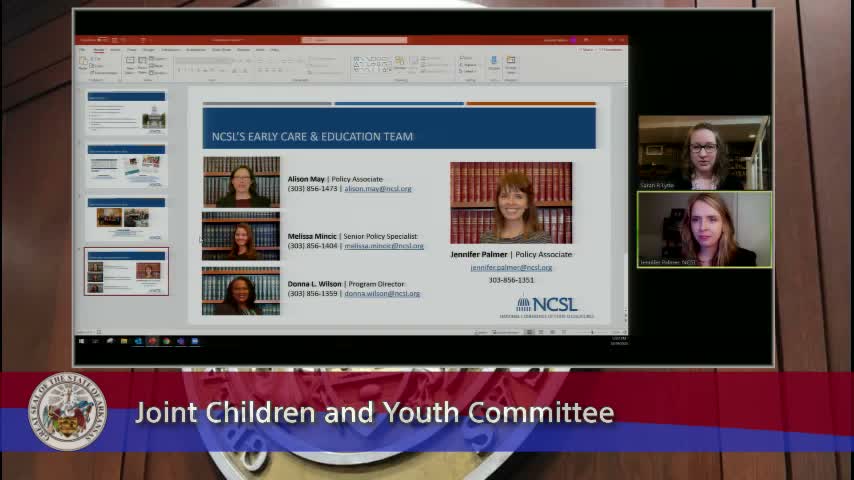
Jennifer Palmer, policy associate at the National Conference of State Legislatures (NCSL), framed the presentation and described NCSL's role in summarizing state legislation and convening policymakers. She introduced Dr. Sarah Lytle of the Institute for Learning and Brain Sciences (iLABS), University of Washington, who delivered the scientific briefing.
Dr. Lytle described brain growth in early childhood as a three‑stage process she summarized as "blooming, pruning and then thriving." She said a newborn's brain is about 25% of adult size and is roughly 92% of adult size by kindergarten, emphasizing that size is not the same as maturity. "Children are born with almost all of the neurons that they will ever have," she said, and the critical developmental task is forming connections between those neurons.
Citing laboratory studies using magnetoencephalography (MEG), Dr. Lytle said researchers measured coordinated activity in language perception and production areas by 12 months of age. She highlighted an unexpected finding at six months: although infants are not producing words, the speaking area of the brain showed activation during language exposure—"almost like a rehearsal kind of activation," she said—indicating preparatory neural processes well before behavioral milestones appear.
Dr. Lytle also outlined the effects of stress: "toxic stress" (extreme, ongoing stress without buffering adult relationships) can disrupt development, while tolerable and positive stressors can be adaptive. She urged policymakers to consider a broad set of policies that affect family stability and caregiving capacity—family leave, affordable housing, living wages, access to health care, and high‑quality child care—to create environments where nurturing relationships can form.
The presenters made materials and policy briefs available to committee members and offered to follow up on submitted questions. Chair closed the segment by asking members to submit questions to staff so presenters could respond in follow‑up communications.