Get Full Government Meeting Transcripts, Videos, & Alerts Forever!
Get email alerts on the Charter Revocation topic
No spam. Unsubscribe anytime.
Committee approves bill aimed at prompting attorney general to act on charter-revocation cases
Summary
Representative Womack—s House Bill 1627, introduced to encourage the attorney general—s office to file pleadings in charter-revocation matters after audit review, passed the City, County & Local Affairs Committee on a voice vote. Sponsor said the bill was prompted by delays in a municipal case.
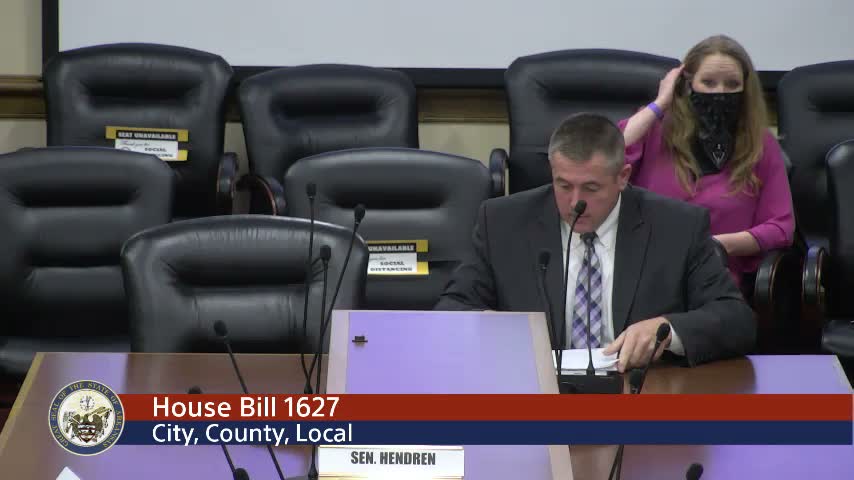
The Senate City, County & Local Affairs Committee approved House Bill 1627, a measure Representative Womack said would create a modest incentive for the attorney general—s office to file pleadings in charter-revocation proceedings after the audit process is complete.
Representative Womack introduced the bill, provided committee members with a timeline handout and said the measure emerged from his work in audit. He told the committee the attorney general—s office "has had the charge" on a charter-revocation matter for roughly eight months, and that "to date, no contact and no reason and no action has been taken by the attorney general's office." He said the bill "basically just provides a little incentive for the attorney general's office to very simply do their job." Representative Womack also said the case that prompted the bill involved the city of Allport but that the bill itself is not limited to that city.
Committee members asked clarifying questions about the timeline and background; no members of the public rose to speak against the bill. The committee transcript records a motion to pass HB1627 with a mover identified as "Senator Sullivan" and a second from "Senator Flippo," followed by a voice vote in which the chair called for ayes and the measure was approved. Representative Womack thanked the chair and committee after the vote.
The committee did not record a roll-call vote or provide a detailed tally in the transcript. The bill—s sponsor characterized the change as a procedural incentive to prompt existing enforcement responsibilities rather than creating a new enforcement power or a city-specific remedy.