Get Full Government Meeting Transcripts, Videos, & Alerts Forever!
Get email alerts on the Police Reform topic
No spam. Unsubscribe anytime.
Arkansas committee advances bill tightening police‑agency rules, requiring full‑time chiefs and codifying part‑time ratios
Summary
The Senate City, County & Local Affairs Committee gave a do‑pass recommendation to House Bill 1197, which shortens the inactive‑agency threshold, requires a full‑time police chief for agencies, codifies a two‑to‑one part‑time‑to‑full‑time officer ratio with waiver authority, and clarifies separations during investigations.
The Senate City, County & Local Affairs Committee on the record recommended approval of House Bill 1197, a package of changes aimed at tightening oversight of local law‑enforcement agencies.
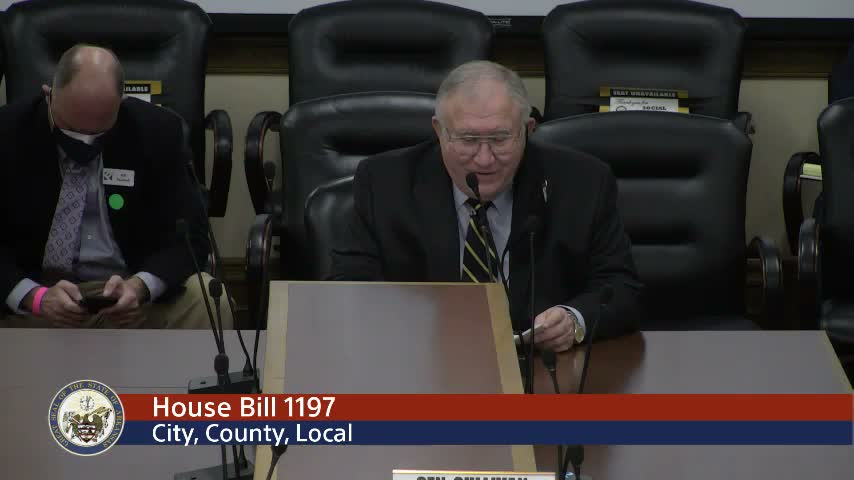
Representative Dowby, speaking for the bill, said the measure implements several recommendations from the governor’s task force on law enforcement. Dowby said the bill shortens the definition of an “inactive law agency” from 12 months to six months, meaning newly formed or reactivated agencies must appear before the Commission on Law Enforcement Standards and Training to demonstrate readiness and discuss matters including funding, use‑of‑force policy and vehicle‑pursuit rules.
The bill also replaces the phrase “bias based policing” with “racial profiling” in state code to align with federal reporting conventions, and would require every law‑enforcement agency to employ a full‑time police chief. “This is a major change for some of the smaller towns and smaller entities,” Dowby said, noting that some small departments have not previously had a full‑time chief.
On staffing, HB1197 would codify a default ratio allowing two part‑time officers for every one full‑time officer, with an explicit waiver path through the commission for departments that can justify a higher ratio. Dowby said the authors estimate the change would affect roughly 20–25 departments and that the commission will work with impacted agencies before any requirement takes effect.
Jamie Cook, secretary of the Arkansas Department of Public Safety and director of the Commission on Law Enforcement Standards and Training, told the committee that Arkansas statute (cited in committee as “12 12 14 o 3”) already requires agencies to adopt a policy on racial profiling and that existing policies commonly address a broader set of biased policing concerns. “The law specifically … makes a requirement for every law enforcement agency to have a policy on racial profiling,” Cook said, adding that departmental policies typically include protections for other categories such as religion and gender.
Committee members pressed sponsors on whether replacing language previously titled “bias based policing” with “racial profiling” would exclude non‑racial biases; sponsors and counsel said the statutory definition of racial profiling in Arkansas covers race, national origin, ethnicity and religion, and that other biased policing remains unlawful under current law.
Senator Flowers moved a do‑pass recommendation; Senator Johnson seconded. The committee took a voice vote and the chair announced the bill passed out of committee with a do‑pass recommendation.
The measure now moves to the full Senate calendar for further consideration.