Get Full Government Meeting Transcripts, Videos, & Alerts Forever!
Get email alerts on the Court Fees Payments Modernization topic
No spam. Unsubscribe anytime.
Senate committee pauses bill to let clerks accept card payments, asks drafting fixes
Summary
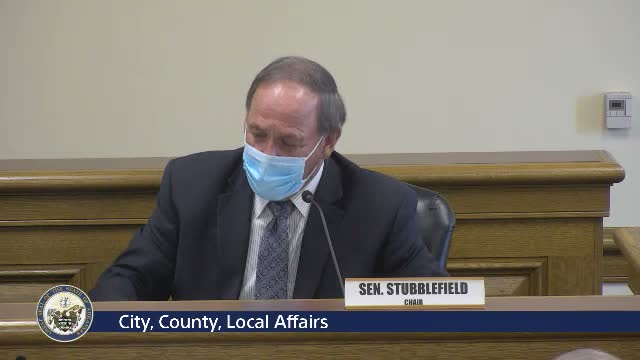
The Senate City, County & Local Affairs Committee heard House Bill 1183, which would let circuit clerks accept debit/credit cards and pass processor fees to payors. Members raised drafting questions about references to district courts and third-party fees and agreed to pull the bill for clarifying amendments.
A Senate City, County & Local Affairs Committee on Tuesday heard House Bill 1183, a measure to let county circuit clerks accept debit and credit cards for records, filings and fines and to pass on the card-processing fee to the person making the payment.
Sponsor Senator Ballinger told the committee the bill is largely ‘‘cleanup’’ aimed at modernizing clerk offices and easing service to constituents, and that it would allow clerks to pass through only the processor’s transaction fee rather than mark it up for profit. "They now have the ability to take a debit card or credit card and then be able to pass on the fees that they pay for the debit card or credit card to the individual," Ballinger said.
Sharon Blunt Baker, Crawford County circuit clerk and legislative chair of the Arkansas Circuit Clerk's Association, said automation is driving the change. "As we automate our offices, this is something that would make things easier for us," she told the committee.
Lawmakers used the hearing to probe drafting details. Senator Flowers flagged wording that appears to mix circuit- and district-court provisions, noting one clause says a district court "shall" accept personal checks while similar language for circuit courts says they "may." "A district court does not accept payments of circuit court fines," Flowers said, arguing the bill should clearly distinguish which fines each court may collect.
Ballinger and Blunt Baker said district courts were included to clarify that their law is unchanged and that clerks reached out to district-court officials; they acknowledged the section title and phrasing could be clearer and that an amendment would likely fix the issue.
Members also pressed on limits for third-party processors. Senator Johnson asked whether the bill would permit counties to pass through only the actual processor fee and not use the arrangement as "a profit center." Ballinger pointed to language capping the pass-through at the processor's fee and to a later clause prohibiting state political subdivisions from adding an additional transaction fee on top of third-party charges.
Committee members raised procurement concerns about flat per-transaction fees charged by some vendors (the discussion referenced typical flat fees of $7–$8 for online transactions). One member asked about contract exit clauses if a county is locked into a high-fee agreement; Ballinger and the clerk said procurement choices and elected officials' responsiveness should limit abuse and advised careful contracting.
The committee also reviewed a cleanup removing an obsolete 50-cent reference and directing clerks to an existing code section for fee schedules. Ballinger cited fee examples set in statute ("$15 first page, $5 each additional page") and said changes to those amounts would require returning to the legislature.
After debate about clarity and scope, Ballinger agreed to "pull it down" and return with amended language; the committee accepted that plan and did not vote on the bill. The committee adjourned with the expectation the measure will be refiled with clearer drafting.