Get Full Government Meeting Transcripts, Videos, & Alerts Forever!
Get email alerts on the Public Notice Policy topic
No spam. Unsubscribe anytime.
Lawmakers weigh newspapers’ role in public notices as state officials outline digital option
Summary
At a City, County & Local Affairs Committee hearing, Arkansas Press Association leaders urged keeping printed newspaper notices and a free APA hub, while the administration said an electronic public-notice system could save the state 'hundreds of thousands of dollars' and merits further study.
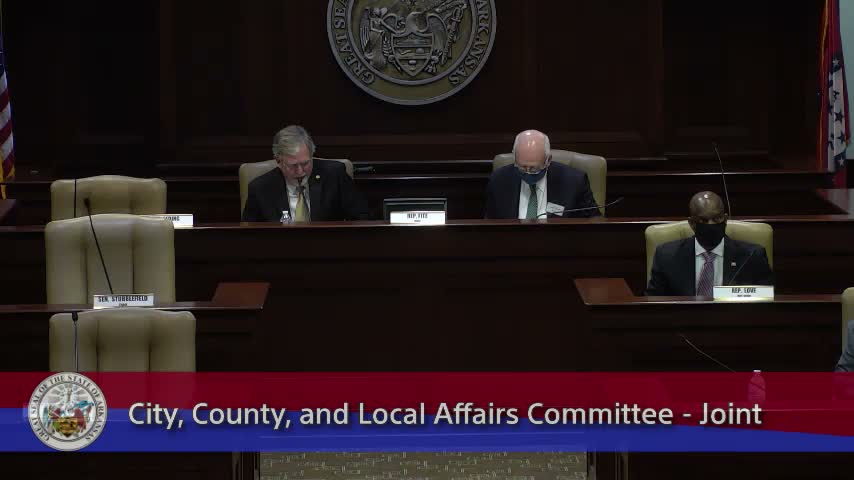
Members of the City, County & Local Affairs Committee on Monday heard competing testimony over how Arkansas should publish legal and environmental public notices.
Representatives of the Arkansas Press Association told the committee that newspapers remain the most reliable method to notify the public and preserve an evidentiary paper trail. Rusty Turner, president of the APA, said, "Print can't be manipulated. It can't be hacked." He and Lynn Hamilton of the Arkansas Democrat-Gazette said APA member papers publish notices in print and also post them on a searchable APA site (publicnoticeads.com/ar), which they described as a free statewide clearinghouse.
"We've done so through expanding our digital footprints while remaining true to the print medium," Turner said, arguing that print plus digital best serves Arkansans, especially older residents and those lacking broadband.
Administration witnesses described a different set of priorities. Amy Fetcher, secretary of transformation and shared services, told the committee that an electronic posting mechanism could save the state "hundreds of thousands of dollars each year" and that roughly 600 statutes refer to newspaper or printed notices. Bob Sanders, general manager of the Information Network of Arkansas, described features of a possible multi-agency digital system — searchable filters, geographic/topic subscriptions, email and push notifications, social-media distribution and the ability to mirror notices on agency sites.
Committee members pressed both sides for detail. APA witnesses emphasized that state law caps public-notice charges at a newspaper's classified-ad rate and noted that the association already hosts uploaded notices for free; Hamilton said a small newspaper notice typically costs about $80 and that the Democrat-Gazette's subscription offering costs $34 per month for a seven-day replica. APA representatives also cited a failure in Newton County as part of the impetus for the discussion.
Administration witnesses said there is no active plan to build a state-run system but urged that a cost-comparison and consistent public-facing approach would be useful. Fetcher and Sanders said funding, security and administrative costs would need analysis and that some agencies already use specialized notification systems that could be integrated.
Several legislators said a hybrid transition would be appropriate given rural broadband gaps. Representative Kavanaugh and others recommended reviewing and amending statutes that require printed notices where they may be outdated. The committee asked the witnesses to provide more precise data — including which notices are paid for directly by state agencies vs. applicants, circulation figures for areas with limited broadband, and cost estimates for a state-hosted system — before any legislative action.
Next steps: witnesses welcomed participation in an independent study of public-notice methods, and the committee requested follow-up information and a cost comparison between the existing newspaper-based model and potential state-run alternatives.