Get Full Government Meeting Transcripts, Videos, & Alerts Forever!
Get email alerts on the Tobacco Regulation topic
No spam. Unsubscribe anytime.
Senate committee advances HB 1980 to streamline tobacco permits and remove seldom-used enforcement language
Summary
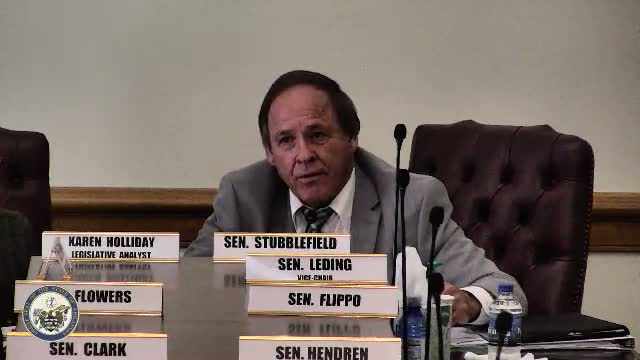
The Senate City, County & Local Affairs Committee voted to pass House Bill 1980, an agency 'cleanup' measure that restructures tobacco permit categories, removes a 30-day post-sale permit window that has caused buyers to inherit fines, and relocates some enforcement-related language to agencies better suited to handle it.
The Senate City, County & Local Affairs Committee on an internally scheduled meeting considered House Bill 1980, an agency bill intended primarily to clean up and reorganize state tobacco statutes. Representative Andy Davis, the House sponsor, and Steve Good, director of tobacco control, told the committee the measure mainly removes outdated or repetitive language, clarifies ownership and permit rules, and eliminates a 30-day transition window that has caused new purchasers to discover unexpected fines or suspensions after completing a sale.
"This bill is not about encouraging people to use tobacco products or not; it's simply about the duty of the state to regulate them," Representative Andy Davis said while explaining the bill was intended to make the statute clearer and easier for the agency to administer. Steve Good, director of tobacco control, said the bill also adjusts permit categories so merchants can select a permit that matches their business structure and avoid paying for unnecessary permit types.
Goode described two principal technical changes. First, the bill swaps certain permit fee assignments so that businesses selling a broader mix of products pay a higher fee and single-purpose vendors pay less. Second, it removes the 30-day post-sale period that previously allowed new owners to apply after completing a sale; under the bill, prospective owners must obtain a permit before finalizing a transaction so they learn of any outstanding fines or suspensions in advance. "If you do all 3, we're combining them to 1 $1,000 permit," Goode said, describing how manufacturer, wholesaler and retail permits currently priced at $500, $500 and $100 could be consolidated for businesses that perform all three activities.
Committee members pressed officials on enforcement mechanics and potential unintended consequences. Senator Sandra Flowers asked why the agency does not place liens on property to secure fines; Goode said the agency has typically used consent orders and payment plans and has not often resorted to liens but that the bill would give the agency authority to pursue debts in other ways. Several senators asked about language moved in the draft that permits civil penalties up to $5,000; staff said that provision was not new law but had been moved within the code for clarity.
Representatives and the director acknowledged the committee that some workplace-safety and retail-cleanliness provisions in older drafts likely fall under public-health agencies rather than the Tobacco Control Board. Steve Good said the board is a law-enforcement agency focused on products and youth access and conceded that provisions addressing retail sanitation or workplace gloves would be better handled by the Department of Health or another agency with health-standards expertise. Representative Davis said he would work with the Cancer Society and other stakeholders on language or to seek future legislation or interagency agreements if necessary.
Michael Kacke, government relations director for the American Cancer Society Cancer Action Network, testified in opposition to portions of the draft that reduce the board's rulemaking authority and expressed concern about removing provisions tied to workplace safety, childproofing and labeling. "To remove power from a board in regards to making rules and putting them in specifically with the director is something that I think should be discussed by this committee and by and considered by the senate," Kacke said, urging the committee to ensure any regulatory responsibilities are appropriately reassigned.
After brief closing remarks from the sponsor reiterating the bill's cleanup purpose, the committee took a voice vote on a motion to "do pass." The motion and second were recorded on the transcript but not attributed to individual members; members responded "aye," and the chair declared, "Bill passes." The committee then adjourned.
Notes: the transcript shows inconsistent spellings of the sponsor's name (variants include "Rapert," "Raper," and "Rapper"). The record does not specify a roll-call tally or name the motion maker or seconder; it records a committee voice vote and the chair's declaration that the bill passed.