Get Full Government Meeting Transcripts, Videos, & Alerts Forever!
Get email alerts on the Refugee Resettlement topic
No spam. Unsubscribe anytime.
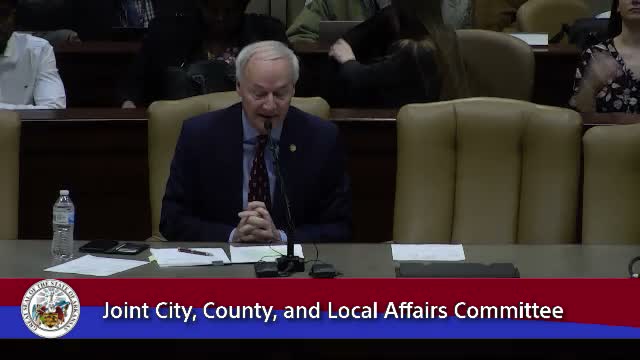
Governor Hutcherson defends limited refugee resettlement, says vetting and local consent are in place
Summary
At a Senate City, County & Local Affairs Committee hearing, Governor Hutcherson defended his decision to accept a limited number of refugees, described federal vetting and local consent letters, introduced resettled families and Canopy Northwest Arkansas’ resettlement director, and faced questions on costs, vetting limits and potential conflicts.
Governor Hutcherson told the Senate City, County & Local Affairs Committee he supports the resettlement of a limited number of refugees to Arkansas after reviewing federal vetting procedures and consulting with state and local officials. "A refugee is not someone who crosses our borders illegally," Hutcherson said, and he outlined vetting that includes interagency security checks, Homeland Security interviews, fingerprint and biometric scans and medical exams.
Hutcherson said changes under the Trump administration reduced the annual refugee ceiling to 18,000 and that the Department of State indicated fewer than 50 refugees are likely to be assigned to Arkansas in FY2020. He said he had written to Secretary Pompeo to express Arkansas’s willingness to accept refugees and that consent letters were submitted from Washington County Judge Joseph Wood and the mayors of Springdale and Fayetteville.
The governor introduced several resettled residents as examples of local integration. He described Lucia Akili Mali, who arrived from the Democratic Republic of the Congo, completed certified nursing assistant training and works in a senior care facility; Hamayoun Abdullah of Afghanistan and Mango Mukadama of the Congo were also introduced. Hutcherson said resettlement organizations such as Canopy of Northwest Arkansas and local churches provide community support.
Committee members pressed Hutcherson on costs and public-safety screening. Senator Stubblefield said Arkansas faces high poverty and food insecurity and asked whether federal funds and refugee eligibility shift costs onto Arkansas taxpayers. Hutcherson cited a federal analysis, saying the Trump administration’s study estimated a $16.9 billion net national economic benefit from refugee economic activity, and reiterated that refugees are legally eligible for mainstream federal benefits after arrival.
On security, members asked whether enhanced vetting could still miss threats. Hutcherson acknowledged no vetting system guarantees zero risk but said he had been briefed by former Department of Homeland Security colleagues and was confident in the current process. When Representative Whitaker asked whether any terrorists had come through the refugee program historically, the governor replied, "No."
Senator Garner read language in the executive order requiring written local consent for placements and said he could not find Washington County or the two mayoral consent letters posted on the State Department’s website. Hutcherson responded that those letters had been provided to Secretary Pompeo and that the planned initial relocations would be focused in the Springdale/Washington County area. He added that freedom of movement in the United States means refugees could later relocate for employment but initial placements follow the Department of State assignments.
Senator Rasch raised an unrelated question about a private law firm’s clients and state grants; Hutcherson said he has no association with his son’s Hutchison Law Group and could not speak for that firm’s clients.
The committee did not take any formal action on the governor’s statement. The record shows Hutcherson’s authorization to participate in resettlement runs through 12/31/2020, and he said his office will monitor employment, integration and legal compliance through the year before advising the Department of State on continued participation.