Get Full Government Meeting Transcripts, Videos, & Alerts Forever!
Get email alerts on the Water Providers topic
No spam. Unsubscribe anytime.
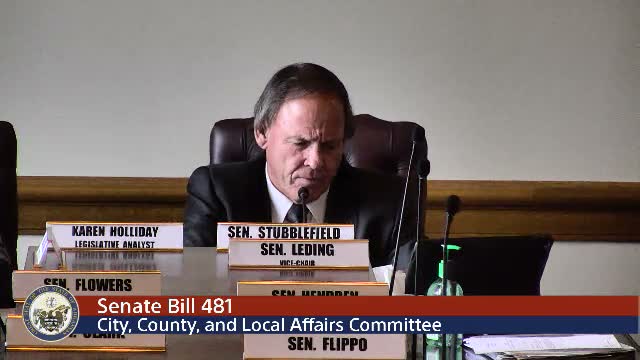
Committee approves wide-ranging water-provider bill after hours of debate over governance and rates
Summary
Senate Bill 481, backed by an 18-month task force, passed the City, County & Local Affairs Committee after hours of testimony; the bill mandates five-year rate studies, training requirements, monitoring of fiscally distressed utilities and creates a process for limited county representation on water commissions tied to thresholds of customers served outside city limits.
The City, County & Local Affairs Committee voted to advance Senate Bill 481 after a lengthy hearing marked by extensive testimony from municipal leaders, water managers and providers.
Senator Vincent Clark, who shepherded the task force behind the bill, told the committee the package addresses political, fiscal and training problems that the task force identified and that the bill requires periodic rate studies (with implementation timelines), training for board members, and monitoring and assistance for utilities in fiscal distress. Clark said the task force’s work was collaborative and that its report reflected many stakeholders’ input.
Jack Critcher of the Arkansas Municipal League told the committee his organization supports most of the bill’s technical reforms but opposes a governance provision that would require municipal water providers that serve significant shares of customers outside city limits to create a water commission and allow county appointees on that commission. "The requirement … that for every 20% of their customers, they are required to have a member on the board" outside the city limits, he said, is the provision the league cannot accept unless it is removed.
Multiple municipal utility managers and representatives — including Jake Short of the Arkansas Water and Wastewater Managers Association, city utility directors from Van Buren, Fort Smith, Fayetteville and Springdale, and Jason Garda of the Arkansas Municipal Power Association — testified that the governance changes could unintentionally strip locally elected officials of practical oversight over rates and operations, create term and removal issues for appointees and raise complications for multi-service utilities and existing wholesale contracts.
Proponents, including Senator Clark and several task-force members, said the 20% and 40% thresholds for adding county representation were intended as a narrow remedy for localities where county customers lack representation and where poor local governance has harmed service or finances. Clark said the bill also contains amendments to exempt certain providers (for example, those regulated by the Public Utilities Commission) and to refine language on two-county systems and wholesale customers.
Committee members pressed witnesses on several points, including how the five-year rate-study requirement would interact with municipal budgeting, whether wholesale or contract service customers would count toward thresholds, and how the bill would affect integrated utilities that provide both electric and water services. Witnesses requested carve-outs for healthy municipal utilities and clearer language for multi-county and contractual situations.
After discussion and several rounds of public testimony, the committee moved and voted to pass the bill. The transcript records a committee vote and the chair’s announcement that the bill passed the committee. Senator Clark said he will continue to work on amendments in the House to address remaining concerns.
The committee adjourned after the vote.