Get Full Government Meeting Transcripts, Videos, & Alerts Forever!
Get email alerts on the Pbm Regulation topic
No spam. Unsubscribe anytime.
Arkansas insurance officials defend Rule 128 to gather PBM data and potentially require dispensing fees
Summary
Insurance Department officials told the Senate Insurance & Commerce Committee they are proposing Rule 128 to gather pharmacy reimbursement data under the PBM Licensing Act and to consider plan‑by‑plan dispensing‑cost additions if reimbursements are not "fair and reasonable," while legislators pressed them on authority, consumer cost and enforcement capacity.
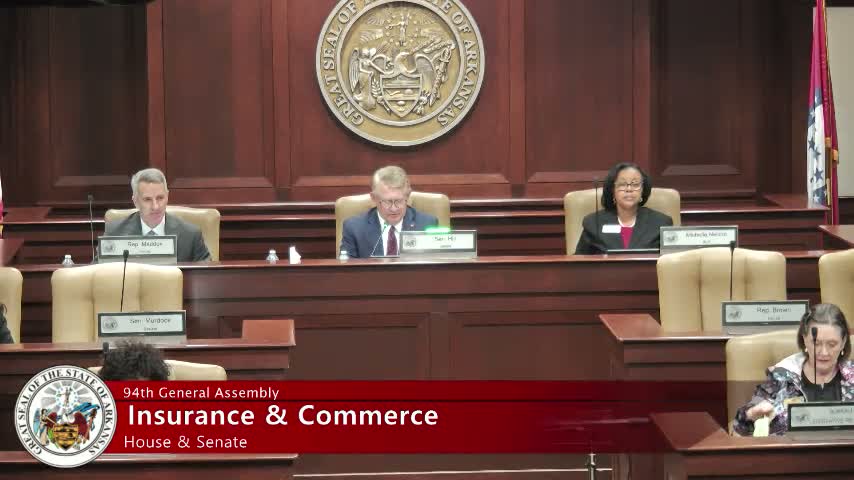
The Arkansas Insurance Department presented proposed Rule 128 to the Senate Insurance & Commerce Committee, saying the rule would require health plans and PBMs to submit prior‑year pharmacy reimbursement statistics and dispensing‑fee data so the department can evaluate whether pharmacies are being paid at levels necessary to preserve an adequate pharmacy network.
"We were receiving about 7 to 10 emails or letters a day," Booth Rand, general counsel for the Insurance Department, told the committee, describing an influx of pharmacy complaints this spring and summer that prompted the rulemaking. The department said it will review each health plan individually and may require a dispensing‑cost addition when the data indicate current reimbursements are not "fair and reasonable."
Why it matters: supporters say the rule gives the department a standardized way to test whether market reimbursements are pushing independent pharmacies out of networks and to set remedies before network adequacy declines. Opponents — including multiple legislators at the hearing — warned a required dispensing fee would likely be reflected in higher premiums or higher point‑of‑sale costs for patients.
What the rule would require and how it would work
The bulletin attached to Rule 128 asks plans to supply statistics such as the average percentage a plan reimburses above NAADAC (the National Average Drug Acquisition Cost), the average dispensing fee currently paid, total drug claims and pharmacy network retention figures. Rand said plans must provide data for plan year 2025 by Feb. 17, 2025 and thereafter file annually on or before March 1. The commissioner will have 20 days to issue a decision after a filing; any required dispensing cost would take effect 30 days after the decision, and plans would have a right to a hearing to challenge it.
Rand said the department is not proposing a single flat fee for the market. "We are reviewing each health plan on an individual basis and not setting a fixed fee for everybody," he told the panel. He also noted the department is using Medicaid's $10.58 dispensing fee as an outside ceiling and said any required dispensing fee would be tailored to the plan's data.
Cost and consumer impact questions
The department's actuary and commercial plans provided estimates for a possible $9 dispensing fee, which Rand cited during the hearing as producing a 2–4% premium impact in the actuarial modeling and roughly a 3–3.4% estimate from major commercial carriers. The Insurance Department said the premium impact would be smaller for lower per‑script fees and that if a plan already had "fair and reasonable" reimbursement the plan might not be required to pay any dispensing fee.
Committee members repeatedly pressed the department on how a required dispensing fee would be applied at the pharmacy counter and whether it would be passed to consumers through copays or premium increases. Rand said the rule permits a plan to collect an assessed dispensing cost through existing copay or coinsurance amounts, but not in addition to them. He acknowledged that translating a plan‑level adjustment into who ultimately pays depends on plan design and employer decisions.
Authority and data transparency
Several legislators questioned whether the Insurance Department already had the tools to gather similar data and why the department had not done a follow‑up to a 2020 limited exam that found PBM affiliates were paid about 2% more than non‑affiliate pharmacies. Rand said the PBMLA explicitly directs the commissioner to adopt rules on PBM network adequacy and that the department lacks standardized definitions of "fair and reasonable" to evaluate plans without a uniform filing framework.
Rand and other department officials also described enforcement capacity: they have an established PBM division with several staff and use contracted actuaries and examiners where needed, but they said more complex or out‑of‑jurisdiction complaints (federal plans, ERISA plans) are harder to resolve through state action.
Pharmacists' testimony and network effects
John Vincent, CEO of the Arkansas Pharmacists Association, told the committee the association supports Rule 128 as a tool to provide transparency and enforcement. Vincent said his review showed a net closure of roughly 40 pharmacies in Arkansas over two years, and he named Little River County and Miller County as areas where independents have closed, leaving only national chains; he also said his members had identified examples of abrupt reimbursement cuts in commercial products.
"There have been dramatic cuts," Vincent said, and he gave at least one example in testimony of an insurer reducing reimbursement levels in a fully insured product in November. He urged the committee to support accountability and faster remedies if the department's data review shows inadequate reimbursements.
Next steps and committee posture
No committee vote on Rule 128 occurred during the hearing. Department officials said they have been receiving some of the requested data under an emergency bulletin and will continue evaluating filings. If the permanent rule is not adopted, the department said it would withdraw the emergency rule and continue ordinary complaint‑driven enforcement, but the plan‑by‑plan dispenser‑cost mechanism would not be available.
The committee asked the department for more granular impact figures; state retirement and benefits witnesses told the panel they could provide only placeholder numbers without the full filings. Mark White of the Arkansas Teacher Retirement System said per‑member impacts vary substantially across plans; Grant Wallace of the Employee Benefits Division said a $1 dispensing fee would be roughly a 0.2% premium increase in his view but that distribution between employer premium increases and point‑of‑sale cost to members depends on plan design.
What to watch next: the department's analysis of incoming data after the Feb. 17, 2025 submission deadline, any commissioner determinations on which plans must add a dispensing cost, and any legislative action that would revise the statutory framework for PBM regulation or change how dispensing costs can be collected.