Get Full Government Meeting Transcripts, Videos, & Alerts Forever!
Get email alerts on the Homeowners Insurance topic
No spam. Unsubscribe anytime.
Arkansas insurance chief: homeowners market is 'hard' as premiums rise and carriers trim exposure
Summary
Arkansas Insurance Commissioner Alan McClain told the Senate committee the homeowners market is 'hard'—premiums and deductibles have risen, several small carriers have exited the state and regulators are weighing mitigation incentives and clearer deductible disclosures to ease affordability pressures.
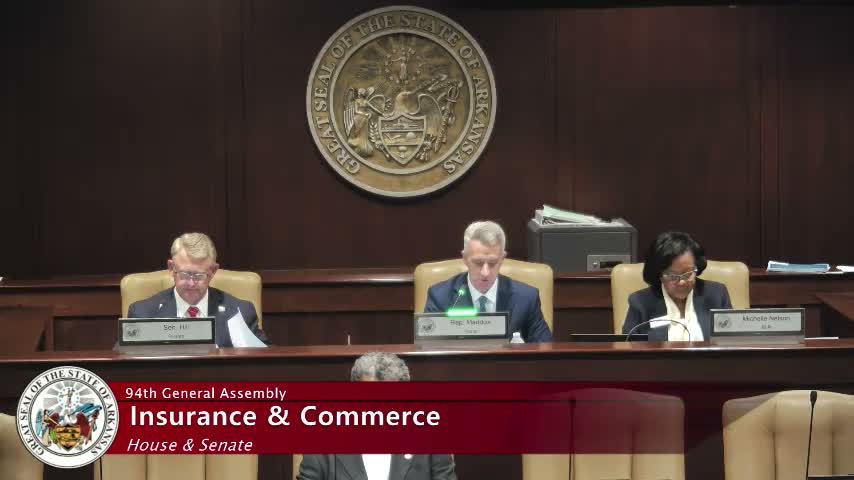
Arkansas Insurance Commissioner Alan McClain told the Senate Insurance & Commerce Committee that homeowners insurance in the state is in a "hard market," with insurers raising premiums, narrowing coverages and using higher deductibles.
McClain said storm frequency and severity—particularly convective storms in Arkansas—along with inflation and supply-chain costs have driven carriers’ expense and loss ratios, which firms then pass to policyholders through rate filings. "It's a hard market," he said, adding regulators must balance availability of coverage against affordability.
Jimmy Harris, compliance director for the Arkansas Insurance Department, told legislators that some companies are using larger or percentage-based wind/hail deductibles and that a small domestic carrier, Farmers Union Mutual (about 18,000 policies), has begun nonrenewals and will complete its exit by Jan. 1, 2025. Harris and McClain emphasized that no major national insurer was among the recent carriers leaving the state.
Committee members asked about consumer options such as very large deductibles or partial coverage. Harris warned those products typically target high-value homes, can trigger coinsurance or actual cash value outcomes, and may not satisfy mortgage holders. "There are carriers that offer large deductibles on the market right now," he said, noting percentage deductibles around 2% are common and that coinsurance can surprise homeowners at claim time.
Lawmakers and department staff discussed mitigation programs other states use to reduce claims costs—examples cited included retrofitting incentives, contractor training, tax credits and Alabama’s grant program to reimburse home hardening measures to a capped dollar amount. Harris said states that require insurers to give discounts for retrofits or offer matching grants report some mitigation uptake and suggested Arkansas study similar options.
On consumer protection, McClain described the department’s consumer services division and said staff receive roughly 150 consumer inquiries or complaints per month, and that the department may investigate disputed claims files or contractor practices. On contractors offering to pay deductibles, staff cautioned that the practice can be a marketing tool but becomes fraud only if the contractor inflates the estimate to absorb the deductible; otherwise the insurer pays based on its own estimate and local labor and material costs.
McClain also reviewed solvency safeguards: Arkansas maintains property-and-casualty and life-and-health guarantee funds funded by assessments on insurers to pay claims for insolvent carriers. He said recent assessments replenished the fund and named United Home and Cameron Mutual as examples whose Arkansas claims were paid by the guarantee fund.
The department told lawmakers it reviews and pushes back on unusually large single-year rate requests and uses contracted actuaries for major filings. Staff estimated average homeowners rate activity in 2023 ranged roughly 15–20% statewide and said regulators aim to limit sudden high individual impacts where possible.
The committee did not vote on a specific policy but asked the Insurance Department to provide written examples of mitigation and disclosure policies other states have used and to continue consumer outreach.