Get Full Government Meeting Transcripts, Videos, & Alerts Forever!
Get email alerts on the Drug Costs Insurers topic
No spam. Unsubscribe anytime.
Blue Cross, Centene tell Arkansas committee that drug costs and PBM disputes are driving rate pressure; providers press for QPA transparency
Summary
Blue Cross and Centene officials told the Senate committee rising prescription‑drug spending and medical claim trends are pushing 2025 rate increases, and they defended arbitration processes under the No Surprises Act while providers warned QPA opacity and arbitration delays harm out‑of‑network clinicians.
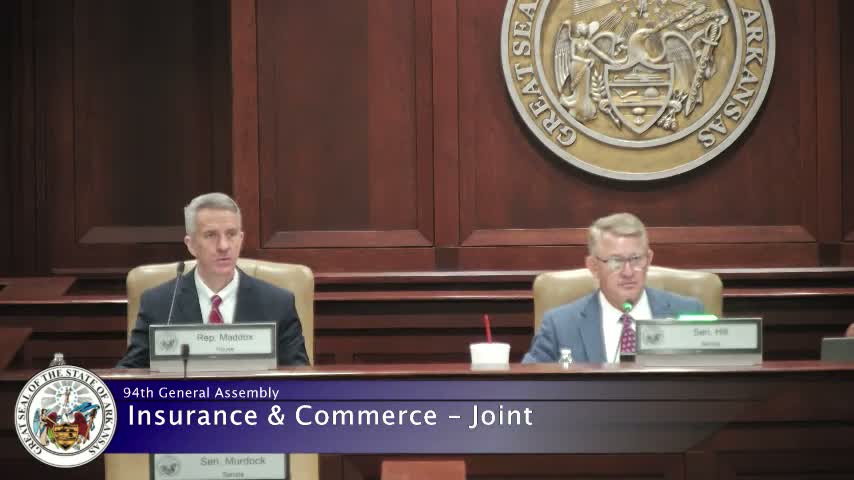
Representatives of Arkansas Blue Cross and Centene appeared before the Senate Insurance & Commerce Committee to discuss the No Surprises Act, arbitration processes and the drivers of rising health‑care costs in Arkansas, including a sharp increase in prescription‑drug spending.
Max Greenwood, senior representative for Arkansas Blue Cross and Blue Shield, summarized the federal No Surprises Act (NSA), saying it protects consumers from out‑of‑network balance billing in narrow situations (for example, when patients receive services from out‑of‑network clinicians during an in‑network facility visit). He explained the qualifying payment amount (QPA), open negotiation and the independent dispute resolution process: if a provider rejects the QPA they can attempt open negotiation and, if unsuccessful, go to binding arbitration. Greenwood told the committee Blue Cross uses a third‑party vendor to manage arbitration and that the vendor is paid by the insurer.
Greenwood and Centene’s Jack Hopkins said insurers expect rate increases in 2025 driven by higher medical claim trends and a surge in prescription drug spending — Greenwood said drug spending in his lines rose from roughly 17% of total spend in 2014 to more than 35% in the current year. Greenwood said Blue Cross has increased outpatient and ambulatory surgery fees and implemented a special pricing methodology for oncology drugs — raising reimbursement for certain oncology drugs by about 33% and prorating adjustments back to earlier this year to make oncologists "whole," he said.
Lawmakers pressed Greenwood on transparency and on wide reported price discrepancies for specific drugs. Greenwood said QPAs are proprietary, and he offered to research specific examples where public price listings and plan or specialty channel prices diverged. Several legislators cited cases where a generic oncology drug (referenced by the committee as Imatinib/Gleevec) showed dramatically different public and plan prices; Greenwood asked members to send drug names so his team could investigate.
Providers raised separate concerns in public comment. Charles Mason, a Cabot physician who previously testified, said the NSA and current QPA process have limited out‑of‑network physicians’ ability to negotiate fairly. Mason said his practice has seen about a 30% reduction in some payments over two years and described lengthy open negotiation and federal mediation timelines — he asked insurers to meet with providers to find workable solutions. Greenwood agreed to have Blue Cross staff follow up with the physician and to ask Centene to do the same.
Ending: Insurers promised to supply additional data at lawmakers’ requests — on QPA practices, specific drug pricing examples, and quantified estimates of cost impacts from recent legislation — and to meet with affected providers to try to resolve individual payment disputes.