Get Full Government Meeting Transcripts, Videos, & Alerts Forever!
Get email alerts on the Adfa Qap Reform topic
No spam. Unsubscribe anytime.
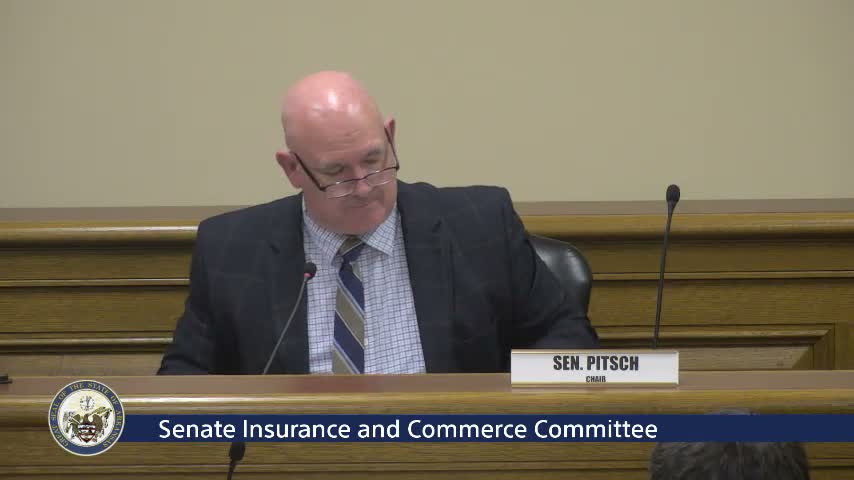
Senate committee approves Sullivan plan to change ADFA appointments and district allocations for housing tax credits
Summary
The Senate Insurance & Commerce Committee passed an amended bill by Senator Sullivan to reconstitute the ADFA board (4 governor/4 senate/4 house appointees), require consideration steps for appointees, and change some Qualified Allocation Plan (QAP) rules including immediate reallocation of unused tax credits; ADFA members testified against the district allocation mechanics.
The Senate Insurance & Commerce Committee voted to report an amended bill from Senator Sullivan that restructures appointments to the Arkansas Development Finance Authority board and changes aspects of the state’s Qualified Allocation Plan for low-income housing tax credits.
Senator Sullivan, sponsor of the legislation, said the amendment clarifies confirmation procedures and adds guidance for how appointing authorities should consider potential appointees. "It's hard to find people to serve on these boards sometimes," he told the committee, explaining the amendment adds factors to ease appointment decisions and changes wording on award allocation to "in a manner that is substantially equal." He also said unused tax credits "may be immediately allocated to the use of 1 or more applications," and outlined staggered initial terms for reconstituted board seats.
The measure drew opposition from several ADFA board members and housing stakeholders who warned the bill’s mandated distribution mechanics could reduce flexibility and exacerbate inequities. John Chadwell, who identified himself as "a member of the board representing the First Congressional District," told the committee that forcing 25% allocation by congressional district risks limiting applicants in larger districts and could reduce the competitiveness that has allowed some areas historically to win larger shares. "If we divide this by 25%, then 29 counties are gonna be competing for a quarter of the money," Chadwell said, arguing the change could "inversely hurt" some districts.
Seth Mims, an ADFA board director with a background in affordable housing, said the QAP has reduced fraud and improved project outcomes and that the proposal appeared rushed. Mims said his board has been making iterative changes to address unintended consequences and asked the committee to slow the process: "I would ask that this bill not be passed on to the house. I would like to either spend some more time with Senator Sullivan," he said.
Brian Scoggins, identified as president of ADFA, presented ten years of application and award data compiled for the committee and explained oversubscription and the treatment of 4% noncompetitive applications. Scoggins told members the packet includes year-by-year data, and he offered to answer questions about patterns of awards.
Committee members pressed sponsors and witnesses on how award distribution is currently governed by population-based metrics rather than strict county counts, and on whether the changes would be reversible. Senator Sullivan said the measure could be tried for two years and he would return to repeal or revise it if necessary.
Senator Hickey moved to pass the bill as amended; Senator Elliott seconded. The committee approved the bill by voice vote and the chair announced the bill "has passed" out of committee and will proceed to the Senate floor for further action.
The committee record shows substantive concerns from ADFA board members about the mandated allocation mechanics and the immediate rollover rule; sponsors said the goal is increased legislative participation in appointments and a more streamlined allocation process. The committee did not record a roll-call tally; the approval was by voice vote.
Next steps: the bill, as amended, will go to the Senate floor. Sponsor Sullivan committed to return with additional amendments if committee members or stakeholders provide further information that demonstrates the measure needs revision.