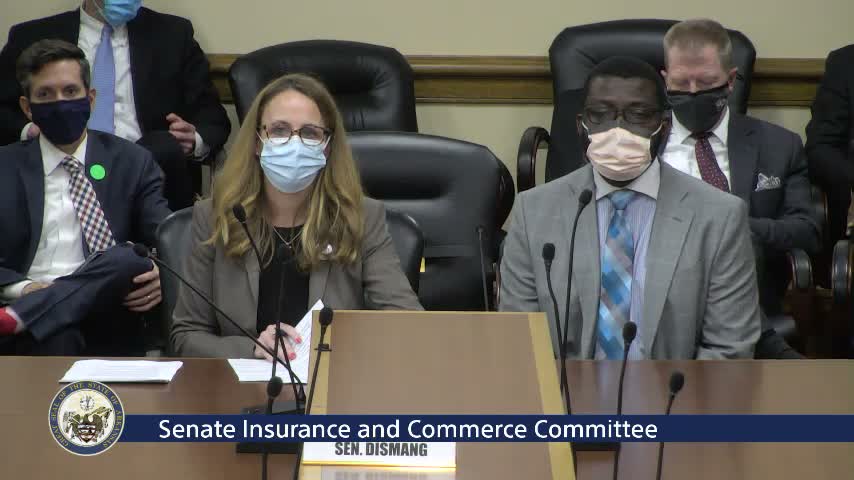
Senate committee approves bill requiring insurers to cover colorectal screening beginning at 45
Loading...
Summary
The Senate Insurance & Commerce Committee passed Senate Bill 309 as amended, lowering the recommended screening age for colorectal cancer from 50 to 45 and tying covered tests to U.S. Preventive Services Task Force guidance; the amendment also requires follow-up colonoscopies stemming from A/B-rated screening tests to be treated as screening with no cost sharing.
Senate Bill 309, a measure to lower the insured screening age for colorectal cancer from 50 to 45, passed the Senate Insurance & Commerce Committee on a voice vote after an amendment tying coverage to U.S. Preventive Services Task Force (USPSTF) recommendations was accepted.
The bill’s sponsor, Senator Missy Irvin, introduced the measure and said it aims to increase early detection in Arkansas, which she described as one of the deadliest states for colorectal cancer. "The purpose of the bill is to try to...lower the age from 50 to 45 to catch more colorectal cancers," Irvin told the committee. She cited state and national statistics and survivors in the legislature to frame the public-health rationale.
Why it matters: Lowering the insurance-covered screening age is intended to increase early detection when treatment is most effective. Irvin cited the American Cancer Society’s estimate that early detection yields a five-year survival rate of roughly 90 percent compared with about 14 percent for cancers discovered after they have spread. Committee witnesses and medical experts told senators that the USPSTF grades (A and B) indicate screening recommendations for different age brackets and provided the scientific context for the amendment.
Key provisions and coverage details: The amendment adopted by the committee ties covered screening to USPSTF A and B grade recommendations and clarifies that certain at-home stool-based tests (for example, Cologuard) that are A/B rated would be covered beginning at age 45. Committee testimony from the insurance department explained the USPSTF age categories: Grade A recommendation covers ages 50–75 and Grade B covers ages 45–49. Sponsor and witnesses emphasized that when a stool-based screening test is positive, the follow-up colonoscopy would be treated as a completion of the screening episode rather than a diagnostic procedure — eliminating patient cost sharing for that follow-up in the bill’s language.
What supporters said: Brian Gettle, associate director of advocacy at Exact Sciences (maker of Cologuard), told senators the bill helps expand access to at-home screening options included in USPSTF guidance and said pandemic-era screening declines make outreach and coverage important. "This legislation would cover all the A and B rated tests from the Task Force including Cologuard," Gettle said when describing the product and its public-health impact.
Questions and concerns: Committee members pressed for specifics about how insurers would treat different test grades and whether patients could face out-of-pocket costs when non‑A/B tests are used or when follow-up diagnostic steps are required. Dr. Jonathan Lowry, a UAMS professor of surgery called to explain testing categories, and an insurance department representative responded that A and B grades are the relevant benchmarks insurers historically used and that the amendment reflects insurers’ and the department’s expectations. Senator Elliott asked whether removing A/B distinctions would jeopardize patient care by creating gaps; the sponsor and witnesses reiterated the bill’s intent to preserve coverage for follow-up procedures when screening indicates the need.
Vote and next steps: The committee accepted the insurer-requested amendment and then voted to pass Senate Bill 309 as amended. The bill will move forward in the legislative process as approved by the committee.
Context note: Testimony cited national and state screening statistics, stakeholders’ positions (including the American Cancer Society), and Exact Sciences’ experience. The committee recorded both supportive testimony from the screening industry and clarifying questions from members about patient cost exposure under different testing pathways.