Get Full Government Meeting Transcripts, Videos, & Alerts Forever!
Get email alerts on the Healthcare Payment Models topic
No spam. Unsubscribe anytime.
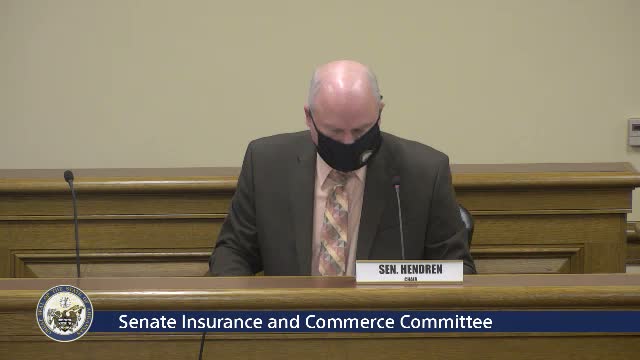
Senate panel advances bill letting specialists offer direct-payment care arrangements
Summary
A Senate Insurance & Commerce committee advanced Senate Bill 168 to broaden a 2017 law so specialists beyond primary care can offer direct-payment (subscription-style) care arrangements; sponsor and witnesses said the model can improve access and continuity, while members raised equity concerns about low-income patients.
Senator Kim Hammer told the Senate Insurance & Commerce Committee that Senate Bill 168 would expand a policy established in 2017 to allow specialists, not just primary care providers, to enter into direct-payment arrangements with patients. "Members of the committee appreciate a positive vote," Hammer said after concluding his remarks.
The sponsor and a guest witness described the model as a subscription-type arrangement in which patients pay a regular fee for a defined set of services. "It's kind of like a Netflix or gym membership type model," the guest explained, saying the model typically guarantees clearer pricing, longer appointments and more same-day access. He said the arrangement is already permitted in about eight or nine other states and that typical fees in direct primary care examples are "somewhere between 75 to $90 a month," sometimes with sliding scales.
Supporters argued the change could let dentists, mental-health providers and physical therapists offer similar arrangements, improve care coordination for patients with chronic needs and reduce provider burnout by enabling longer visits. Committee members pressed on equity and affordability. One member warned that the poorest and sickest patients, who may not be able to afford a monthly fee, could be left behind if the model expands without safeguards. The sponsor responded that the bill is intended to create another option rather than replace insurance coverage and that it could increase access for some underserved patients.
After questions and discussion, the committee took a motion to pass SB168. The motion was seconded and the committee approved the bill on a voice vote.
The committee record shows the sponsor asked members for a positive vote and the measure was advanced by the committee. The bill will return to a subsequent Senate calendar for further consideration according to chamber rules.