Get Full Government Meeting Transcripts, Videos, & Alerts Forever!
Get email alerts on the Health Cancer Coverage topic
No spam. Unsubscribe anytime.
Senate committee advances bill to bar step-therapy requirements for metastatic cancer patients
Summary
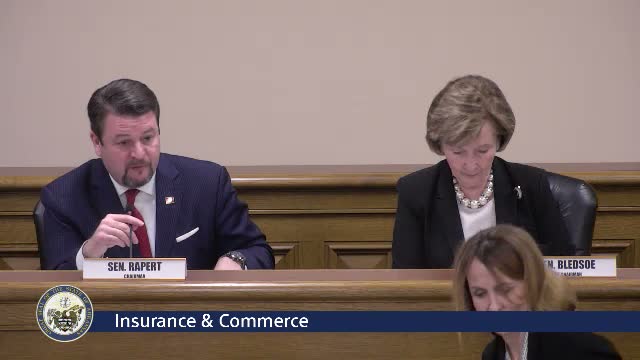
The Senate Insurance & Commerce committee voted to pass Senate Bill 446, which would prohibit health plans from requiring "step therapy" (fail-first) for metastatic cancer patients so physicians can prescribe what they judge best without mandated prior trials of lower-cost alternatives.
A Senate Insurance & Commerce committee on an Arkansas legislative hearing advanced legislation intended to speed access to prescribed cancer drugs for patients with metastatic disease.
Senate Bill 446, introduced by Senator Greg Lettering, would ban step therapy — sometimes called "fail-first" requirements — for people the bill defines as having metastatic cancer. Lettering told the committee the bill’s core provision appears on page 2, line 12 and that the goal is "to make sure that patients get the right medicine as quickly as possible, by prohibiting step therapy." He said step-therapy rules can require patients to try a different, often generic, drug before a clinician’s preferred drug will be covered.
Tori Smith, who identified herself as a stage 4 breast cancer patient, testified in support. "I have stage 4 breast cancer," Smith said. "I don't have time to try new things. I need the things that are gonna — the drugs that are gonna work for me." Lauren Marquette, executive director of Susan G. Komen Ozark, was present and yielded her time to Smith.
Lettering argued metastatic cancer patients lack the luxury of time; he told the committee the median life expectancy for stage 4 breast cancer is about 26 months and that fewer than one in four live more than five years, and he cited recent similar laws in Colorado and New Mexico.
Committee members offered brief thanks and support for Smith's testimony. The chair called for a motion; Senator Johnson moved passage, Senator Bledsoe seconded, and Senator Irvin gave a third. The committee approved the bill by voice vote and the chair announced the bill passed.
The bill will next proceed according to the legislature’s regular floor and committee scheduling. The committee record did not include detailed implementation language about enforcement, specific definitions beyond the bill's text reference, or any fiscal estimates in the hearing record.