Get Full Government Meeting Transcripts, Videos, & Alerts Forever!
Get email alerts on the Blue Envelope Isp topic
No spam. Unsubscribe anytime.
Senate committee adopts interim study to pursue "blue envelope" alert for drivers with autism after personal testimony
Summary
The Senate Public Health, Welfare and Labor Committee adopted an interim study proposal to develop a "blue envelope" program for drivers with autism or other communication disabilities after two witnesses described traffic stops that escalated due to miscommunication.
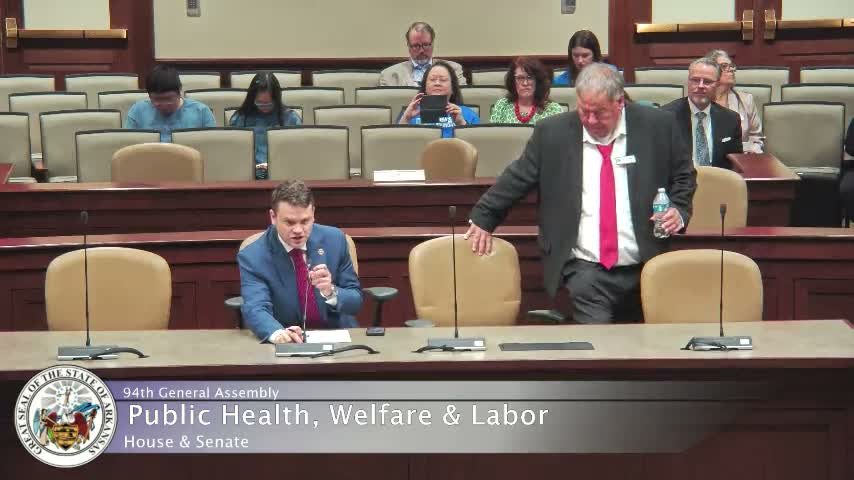
The Senate Public Health, Welfare and Labor Committee on Tuesday adopted an interim study proposal to develop a "blue envelope" program intended to alert officers during traffic stops that a driver has an autism spectrum condition or other communication disability.
Representative Pilkington introduced the ISP and said the idea was modeled on programs in other states. "Like a lot of good pieces of legislation, sometimes it comes from a place we're not expecting," he said, and described the envelope as a way for officers to understand that a driver "has a special need and adequate ways to handle that encounter," improving outcomes for both officers and motorists.
Jonathan Taylor, executive director of the Governor's Council on Developmental Disabilities, told the committee several states have already rolled out similar programs and asked to bring witnesses to share their experiences. Two witnesses testified about traffic stops that nearly or did escalate because of communication barriers. Lud Kosowski, vice chair of the Governor's Council on Developmental Disabilities, recounted a 2004 post-shift traffic incident in which he said confusion and sensory overwhelm nearly led to a crisis. "When you're on the autism spectrum, you can get overwhelmed," Kosowski said, arguing that a standardized cue for officers could de-escalate encounters.
Logan Collins, who identified himself as a truck driver and a member of the Arkansas Autism Foundation, described a July 19 stop near Hazen. Collins said he slowed to 20 mph, pulled onto the shoulder and that the officer escalated the interaction; Collins said he exited the truck, was tased twice and that the episode grew from miscommunication. "I really hope that a bill like this, something that a driver could hand to an officer, could help them understand ... this is just somebody that has a disability, has a communication barrier," Collins said.
Committee members discussed practical details: whether the envelope should contain a standardized card or have information printed on the outside, a checklist or boxes to indicate specific communication needs, and whether standard documents such as driver's license and insurance should be kept in the envelope so handing it becomes routine during stops. Representative Johnson suggested adding a version to alert officers when a child with autism is in the vehicle; proponents agreed to consider extending the concept to parents in such situations.
Lawmakers asked how to ensure uniform adoption across counties. Representative Wooldridge said she wondered why legislation was necessary rather than council-led distribution; Representative Pilkington said a statute would encourage statewide consistency, preventing confusion when counties adopt different approaches.
"Without objection, this ISP is adopted," the chair said, sending the proposal forward for drafting, stakeholder engagement and further work with law enforcement and training entities in the coming months.
Next steps: the committee adopted the ISP and proponents said they would draft standardized materials, consult law enforcement and disability advocates, and return with a more developed bill in the next session.