Get Full Government Meeting Transcripts, Videos, & Alerts Forever!
Get email alerts on the Medicaid Phe topic
No spam. Unsubscribe anytime.
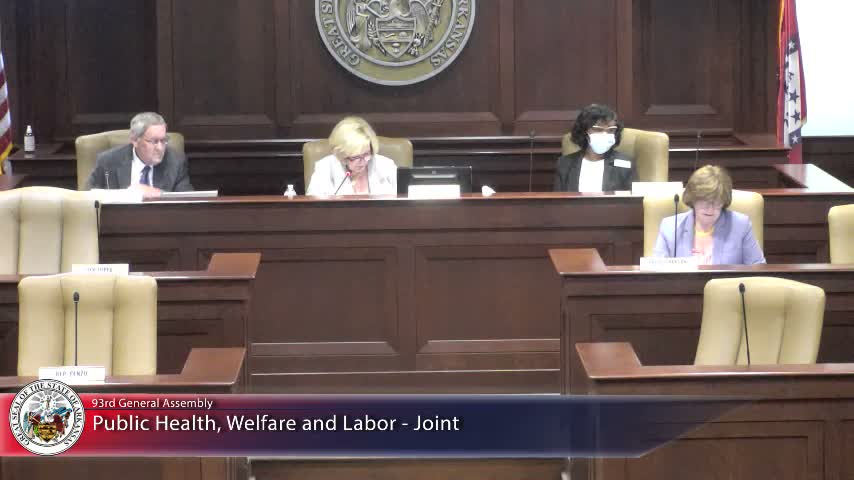
Arkansas DHS outlines Medicaid wind-down plans as federal public health emergency continues
Summary
Arkansas Department of Human Services officials told the Senate Public Health, Welfare and Labor Committee they are preparing a gradual eligibility redetermination and outreach plan as the federal public health emergency and its enhanced Medicaid match evolve; CMS has signaled at least 60 days' notice before ending the PHE and guidance expects a six-month wind-down period.
Mark White, deputy with the Arkansas Department of Human Services (DHS), told the Senate Public Health, Welfare and Labor Committee that the state is still operating under a federally declared public health emergency (PHE) and that federal limits tied to enhanced Medicaid match payments prevent routine disenrollment during the PHE. "Essentially if they are on the Medicaid program as long as this public health emergency extends they have to be left on the [program] even if we think they may have come ineligible unless they die or move out of state," White said.
Why it matters: the enhanced Federal Medical Assistance Percentage (FMAP) reduces the state's share of Medicaid costs while the PHE is in effect, but DHS officials said the enhanced match is conditioned on states maintaining beneficiary eligibility during the emergency. DHS told lawmakers the enhanced match is paid through the quarter in which the PHE ends, and officials said they expect HHS may give states at least 60 days' notice before terminating the federal declaration.
DHS described how it will manage the wind-down. Mary Franklin, director of DHS's Division of County Operations, said CMS guidance expects states to complete their redetermination and transition work within roughly six months after the end of the federal PHE and that DHS will use the 60-day notice to begin identifying and notifying beneficiaries. "We would be handling these cases over that 6 month period of time," Franklin said. DHS plans to continue eligibility redeterminations now (but not act on removals until the PHE ends), to send letters and deploy outreach through community partners, and to post a wind-down plan and guidance on the DHS website.
Numbers and fiscal context: committee members pressed DHS on enrollment and budget effects. Mark White said Medicaid enrollment rose from 960,244 in June 2020 to 1,038,589 in the most recent June figures, an increase of roughly 78,000 beneficiaries across all Medicaid categories. DHS also provided a May count of 270,491 beneficiaries in Arkansas Works (the stateexpansion program). On the enhanced match, White said the state is receiving about $70,000,000 per quarter in additional federal matching funds and, based on current data, the state has been "to the good" overall under the enhanced match even though some individuals cannot be disenrolled while the PHE is in effect.
Questions from lawmakers and DHS responses: legislators asked whether Arkansas could decline the enhanced match to permit immediate disenrollments; White said he would need to consult legal counsel but did not confirm that option was available. Lawmakers asked whether the wind-down would follow the "rolling" process used in prior eligibility changes; DHS said the redetermination would be gradual, with some cases processed quickly by automated checks and others requiring more extensive medical or documentation reviews (particularly waiver populations). DHS also said that certain provider flexibilities used during the PHE (for example, delays in site visits or relaxed fingerprint verification procedures) will end when the PHE does.
Next steps: DHS committed to sharing more detailed materials with the committee, including a Medicaid transformation scorecard and later the wind-down plan and communications materials. The committee filed the DHS report after the briefing. "We'll be using those 60 days to start the process of working through getting notice out to folks," Mark White said.
Ending: DHS reiterated that some details remain contingent on forthcoming CMS guidance and that officials will adapt the state's procedures to comply with federal direction.