Get Full Government Meeting Transcripts, Videos, & Alerts Forever!
Get email alerts on the Visitation Policy topic
No spam. Unsubscribe anytime.
Arkansas committee reviews implementation of 'No Patient Left Alone' law; DHS, Health spell out complaint and enforcement process
Summary
The Senate Public Health, Welfare and Labor Committee heard Department of Human Services and Department of Health reports on Act 311 (No Patient Left Alone Act), effective March 10. DHS and DoH described complaint procedures, enforcement limits tied to federal rules, and reported low numbers of visitation complaints to date.
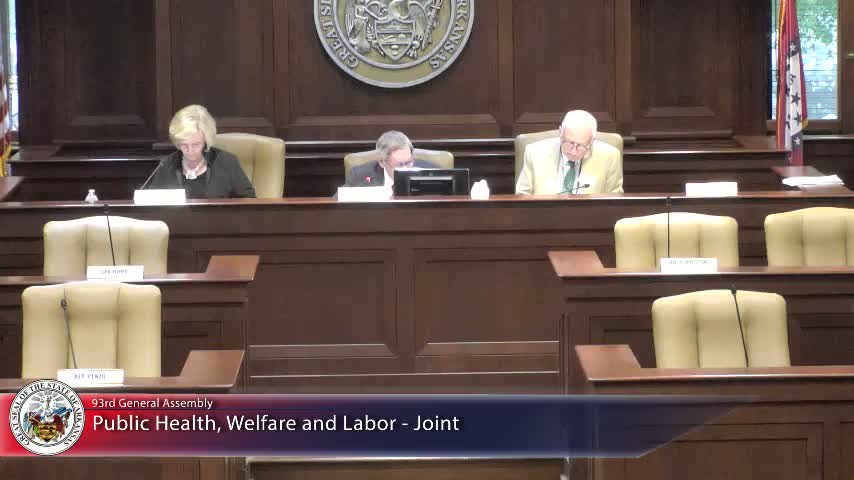
The Senate Public Health, Welfare and Labor Committee on May 20 reviewed how state agencies are implementing Act 311 of 2021, the No Patient Left Alone Act, and what residents should do if facilities restrict visitation.
Mark White of the Department of Human Services told the committee the law, which contained an emergency clause, became effective March 10 and covers visitation rights in long-term care facilities while enforcement is shared between DHS and the Department of Health. "Patients in those facilities have rights to visitation under federal law and those are laws that we're charged with enforcing on long term care facilities," White said.
Melody Jones Blackwell, who spoke for DHS about complaint handling, gave the committee the most concrete data. "As of March the first of 20 21 to May, we've had 14 total complaints come in concerning visitation. Of those 14, 10 were unsubstantiated, 1 was substantiated, and we have 3 that are pending investigation," she said, describing DHS's intake and field-surveyor process for nursing-home investigations.
Representatives and senators pressed DHS on why some families remain unable or unwilling to file complaints. Representative Mayberry said families are often "scared" to file, worried that they will be seen as causing trouble for a loved one who lives in a facility. DHS recommended two options to protect confidentiality: have constituents share information through their elected representative so DHS can follow up without disclosing identities, or use the long-term-care ombudsman program, which works with families and has confidentiality protections.
Department of Health staff described how hospital complaints are handled differently when a hospital is accredited and under CMS "deemed status." DoH reported receiving six hospital visitation complaints, four of which involved emergency departments; four have been investigated and two were recently received and were still in process. Renee Mallory of DoH said that when a complaint involves an accredited hospital and raises immediate jeopardy concerns, the department coordinates with CMS before entering the facility.
Committee members repeatedly asked how agencies reconcile Arkansas's law with federal guidance. DHS and DoH officials said federal infection-control obligations and CMS guidance remain in force and can shape what a facility may lawfully require. DoH emphasized that, even during outbreaks, compassionate-care visitors may still be allowed under certain infection-control precautions.
Several members asked whether hospitals or facilities had been financially penalized specifically for COVID-related visitation limits. DHS said it has issued citations for infection-control violations but could not, at the hearing, confirm whether monetary penalties had been assessed specifically for COVID-rule violations and agreed to follow up with records.
The committee did not take formal enforcement action at the meeting but directed agencies to continue outreach to facilities and to provide follow-up information, including whether monetary penalties had been imposed and the availability of ombudsman contacts.
The committee will revisit related issues in July, and agencies said they will continue to accept complaints through their online portal and hotline.