Get Full Government Meeting Transcripts, Videos, & Alerts Forever!
Get email alerts on the Scope Of Practice topic
No spam. Unsubscribe anytime.
Arkansas committee rejects bill to remove mandatory NP–physician collaboration agreements
Summary
After hours of testimony from nurse practitioners, physicians and researchers, the Senate Public Health, Welfare and Labor Committee declined to advance SB 189, which would have allowed experienced APRNs to seek prescriptive authority without a mandatory collaborative agreement; supporters cited rural access while opponents warned of safety and training gaps.
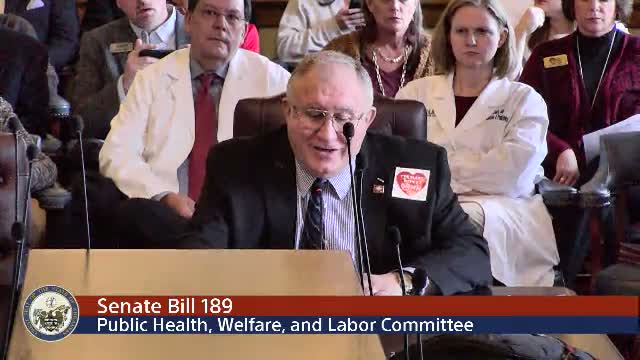
The Senate Public Health, Welfare and Labor Committee heard hours of testimony on SB 189 on the subject of removing mandatory collaborative practice agreements for advanced practice registered nurses, but the panel voted not to advance the bill.
Sponsor Sen. Wallace said the bill would let nurse practitioners with 2,000 hours of supervised prescriptive practice apply for authority to prescribe without a continuing mandatory collaboration, a change she said would expand access in rural Arkansas while excluding Schedule II drugs. "How can one physician supervise 19 clinics from Northeast Arkansas to Southwest Arkansas?" she asked, citing an example of a large physician practice stretching across the state.
Nurse practitioners and clinic owners testified that collaboration requirements impose financial and operational burdens. Karen Reynolds of the Arkansas Nurse Practitioner Association described trained APRNs who cannot provide medication-assisted treatment because they lack collaborating physicians with MAT waiver training and noted that some collaborating physicians charge 10–40% of gross receipts or flat monthly fees; Michelle Boone, a Nashville clinic owner, said she pays about $18,000 a year for a collaborating physician’s signature and that the cost threatens her practice.
Supporters pointed to peer-reviewed studies and federal reports. Economist David Mitchell, director of the Arkansas Center for Research in Economics, summarized academic literature he said shows no measurable difference in primary-care outcomes where nurse practitioners practice independently, and projected conservative state savings in the hundreds of thousands of dollars annually from shifting some visits to APRNs.
Opponents, primarily physicians and physician groups, warned the bill would reduce oversight for complex cases. Dr. Brian Baltz, representing the Arkansas Academy of Family Physicians, and Dr. Amanda Deal, assistant dean for clinical education at NYIT–Arkansas State, emphasized differences in training and urged reliance on new medical-school and residency capacity to address shortages. Judith Goodson offered a family anecdote about a late cancer diagnosis to argue for physician-led care in some rural cases.
The committee adopted an amendment offered by Sen. Wallace to remove specific training-language before debate, then put SB 189 to a vote. After roll call, the chair announced the motion failed and the bill did not advance from committee.
The committee did not record a detailed public tally in the hearing transcript provided; committee staff indicated members requested a short break after the vote. No final change to state law occurred during the session; proponents said they will continue to press access and Medicaid-related issues in other venues.