Get Full Government Meeting Transcripts, Videos, & Alerts Forever!
Get email alerts on the Opioid Safety topic
No spam. Unsubscribe anytime.
Senate committee approves bill encouraging naloxone co‑prescribing for high‑risk opioid patients
Summary
The Senate Public Health, Welfare and Labor Committee passed Senate Bill 505 to allow co‑prescribing of naloxone at defined opioid dosage or risk thresholds, require patient counseling, and provide limited prescriber protections; supporters cited high opioid prescribing and rising overdose deaths in Arkansas.
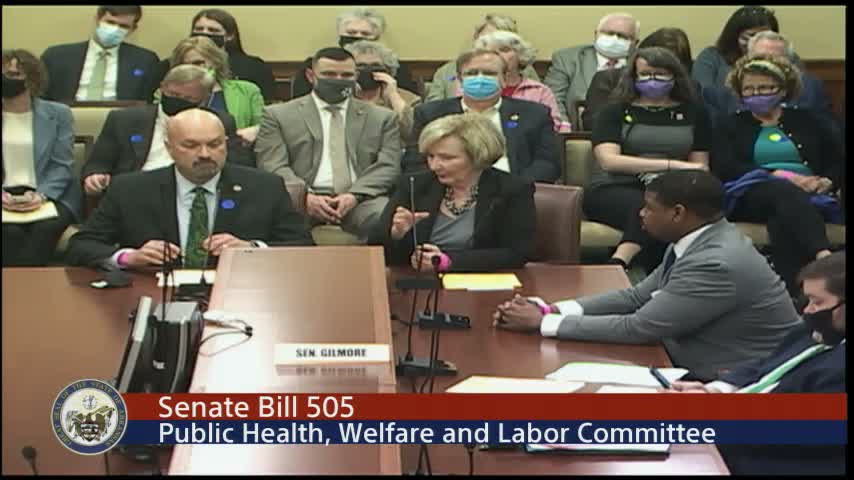
Senate Bill 505, approved by the Senate Public Health, Welfare and Labor Committee, authorizes co‑prescribing naloxone or another opioid antagonist in specified high‑risk situations and requires health care professionals to counsel patients on opioid risks and naloxone use. The sponsor said the change is aimed at reducing overdose deaths and increasing conversations between clinicians and patients.
Supporters told the committee the bill targets three clinical risk situations: patients prescribed opioids at or above a morphine‑equivalent threshold (discussed as 50 milligrams), patients prescribed opioids in combination with sedating medications such as benzodiazepines, and situations where opioids are present in a home accessible to other family members. Kirk Lane from the governor’s office (presenting the bill) described Arkansas’s opioid prescribing rate at roughly 83.2 prescriptions per 100 people, compared with a national average cited at 46.7, and noted a recent uptick in overdose deaths. Dr. Jonathan Goree, a UAMS anesthesiologist and chair of the opioid stewardship committee (speaking as an individual), told the committee the proposal aligns with current clinical practice at UAMS, where clinicians already prescribe naloxone in similar high‑risk settings.
Dr. Goree said the bill would standardize care by increasing counseling and naloxone availability: “All of our patients who are prescribed greater than 50 OMEs or all of our patients who are prescribed co‑prescriptions with other sedating medications, we prescribe naloxone for them, and we…have a conversation with them about the risk and benefits of opioids and how to use naloxone safely.” Supporters pointed to recommendations from the U.S. Surgeon General and Arkansas’s surgeon general and noted that other states that enacted similar laws saw modest decreases in overdose deaths.
There was minimal committee questioning and no public opposition registered. Senator Bledsoe closed in favor, Senator Sullivan seconded the motion to pass, and the committee approved the bill by voice vote. The measure now proceeds to the next Senate floor action per the regular legislative process.