Get Full Government Meeting Transcripts, Videos, & Alerts Forever!
Get email alerts on the Vaccine Preparedness topic
No spam. Unsubscribe anytime.
State epidemiologist briefs committee on COVID trends, vaccine trials and distribution planning
Summary
Arkansas Department of Health epidemiologist Dr. Jennifer Dillehay updated the committee on rising COVID-19 cases, hospitalizations and the state’s vaccine planning. She summarized vaccine candidate types, trial phases, cold‑chain logistics (noting Pfizer’s −70°C requirement), prioritization guidance and the department’s intent to submit a vaccination plan to CDC.
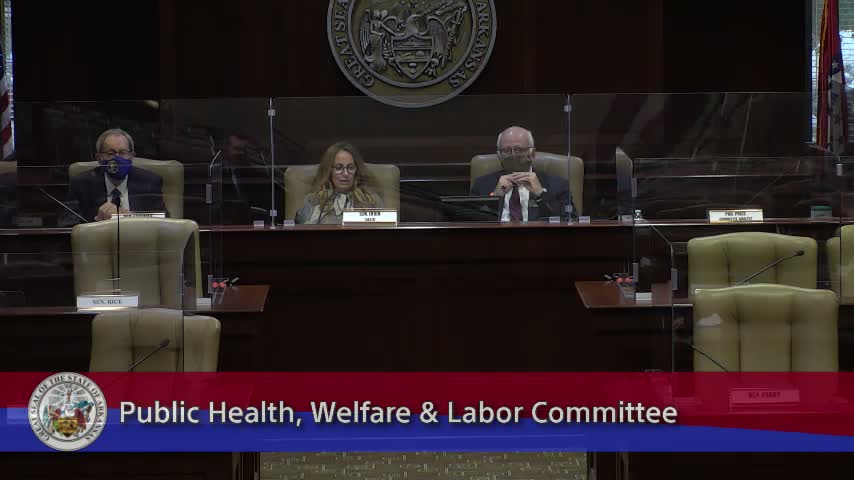
Dr. Jennifer Dillehay, state epidemiologist for the Arkansas Department of Health, briefed the Senate Public Health, Welfare and Labor Committee on national vaccine development efforts and Arkansas’s readiness to receive and distribute doses.
Dillehay reported the state had recorded more than 95,000 confirmed COVID-19 cases and about 1,600 deaths, with roughly 8,000 active cases and elevated hospitalizations (about 587 in hospital as of the prior day). She outlined how vaccine development works — Phase 1 safety, Phase 2 effectiveness, and larger Phase 3 trials — and explained why multiple approaches are being advanced simultaneously.
Dillehay identified several candidate technologies and manufacturers: mRNA vaccines (Moderna, Pfizer), viral-vector vaccines (Johnson & Johnson; AstraZeneca/Oxford), and a protein-based candidate (Novavax). She noted some vaccines require two doses and that Pfizer’s candidate needs ultra-low cold storage (about −70°C), which will require planning for dry ice or special freezers. “There’s 2 other virus vaccines that are in phase 3… one of them is being made by Johnson and Johnson, and they have paused that phase 3 trial to take time to understand whether or not one of the participants who has an unexplained illness…,” she said, describing safety pauses and FDA review.
On distribution planning, Dillehay said the department will submit a vaccination plan template to the CDC and is convening internal and external working groups, including a vaccine medical advisory committee and an ethics subcommittee, to adapt federal guidance to Arkansas. She said initial prioritization will follow CDC and National Academies guidance — health-care workers first and then people at higher risk of severe disease — and that exact groups depend on which vaccine is approved and its safety/effectiveness profile.
Dillehay also cautioned about using point‑of‑care antigen tests for screening: those tests were designed for symptomatic diagnostics and may have different performance in asymptomatic screening; positive antigen results should be confirmed by PCR. The department offered to provide its vaccination plan to the committee staff and return to answer members’ follow-up questions.
Next steps: ADH will submit the vaccination plan to CDC, share the plan with committee staff, and continue convening working groups on distribution and prioritization.