Get Full Government Meeting Transcripts, Videos, & Alerts Forever!
Get email alerts on the Unemployment Insurance topic
No spam. Unsubscribe anytime.
State officials outline $215M plan to shield employers from pandemic UI rate spikes
Summary
AEDC and Workforce Services told the committee Q2 2020 pandemic claims totaled roughly $210M and proposed reclassifying prior CARES Act transfers and requesting an additional $50M to deem $215M a voluntary trust contribution so employer UI rates would not jump in 2021.
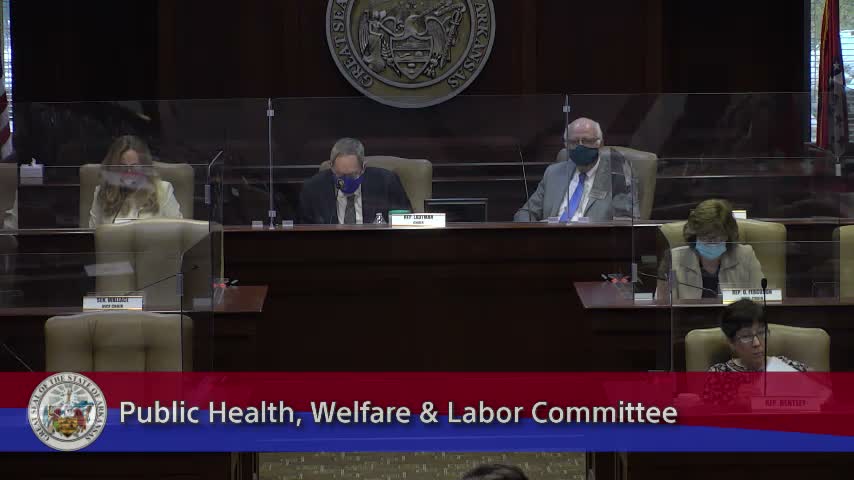
Mike Preston, secretary of commerce and executive director of the Arkansas Economic Development Commission, and Dr. Charice Childers, head of the Department of Workforce Services, briefed the Public Health, Welfare and Labor Committee on the pandemic’s effect on the state unemployment insurance (UI) trust fund and offered an administrative solution to blunt employer rate increases.
Preston summarized the problem: Q2 2020 — the early pandemic peak — generated roughly $210 million in UI charges against employers. The committee previously approved a $165 million CARES Act appropriation to stabilize the fund; Preston and Childers told lawmakers that DWS can administratively reclassify ($165M) previously transferred dollars as a voluntary contribution to the trust fund and requested the committee’s support for an additional $50 million CARES transfer (a presentation to the CARES steering committee was planned) to make the total deemed contribution $215 million, which would cover Q2 charges and prevent a spike in employer tax rates at the next computation.
Key details: Preston said the proposal can be done administratively without an emergency appropriation and that the stabilization action taken in September covers other stabilization needs until the next test date (Sept. 30, 2021). The presenters noted Q3 claims dropped to about $90 million as the economy recovered, but Q2 charges — which factor into 2021 employer rates — remain a concern unless reclassified.
Committee concerns and clarifications: Legislators pressed for details on how fraud and fraud recovery (the department reported $914,709.25 returned to date) affect employer charges, whether recovered funds would be returned to the trust fund (yes), and what statutory ability Arkansas has to issue non-charge relief (the state lacks explicit statutory authority to issue non-charges; an executive order is an alternative but temporary). Senators and representatives asked about future provisions to give DWS more administrative flexibility in prolonged emergencies; Preston and Childers said they will work with the legislature on potential statutory fixes.
Why it matters: Without the reclassification and additional CARES transfer, employers facing high Q2 claims could see average UI tax rates rise by large percentages — one example cited increased the per-employee annual cost from $21 to $340 if no correction was made — which committee members said could impose severe strain on small and medium businesses during recovery.
Next steps: The presenters said they would request the $50 million transfer from the CARES steering committee and work with legislators on possible statutory language to allow case-by-case administrative treatment for future economic emergencies. Committee members offered support for drafting enabling legislation.