Get Full Government Meeting Transcripts, Videos, & Alerts Forever!
Get email alerts on the 5g topic
No spam. Unsubscribe anytime.
UAMS expert tells Senate panel 5G presents little medical risk but exposes rural infrastructure gaps
Summary
Dr. Joseph Sanford told the Senate Public Health, Welfare and Labor Committee that current medical evidence does not show harmful health effects from 5G radio frequencies, but he warned that 5G’s benefits depend on fiber backhaul and that rural Arkansas faces coverage and telemedicine challenges.
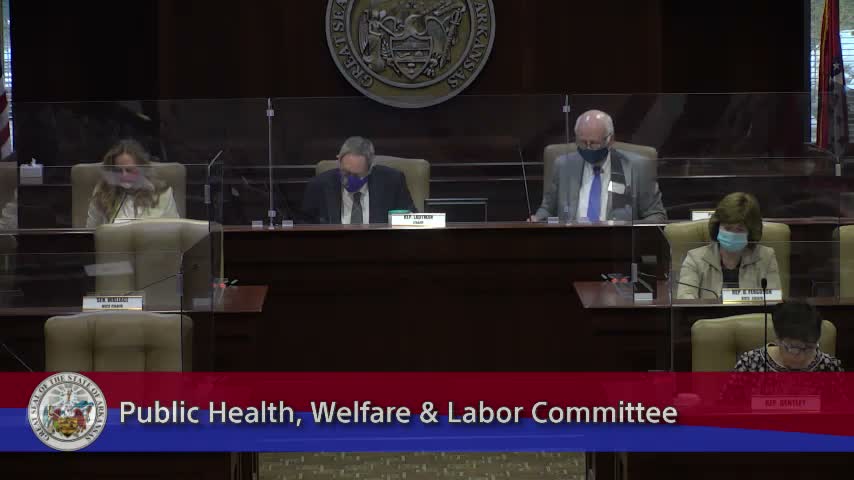
Dr. Joseph Sanford, interim director of the UAMS Institute for Digital Health and Innovation and chief clinical informatics officer for UAMS, told the Senate Public Health, Welfare and Labor Committee that current medical evidence does not support claims that 5G cellular networks cause harmful health effects. He spoke at the committee’s meeting after Representative Lademan asked for a briefing on what the incoming 5G network may mean for health care services.
The UAMS official gave an overview of 5G’s technical bands — low, mid and millimeter-wave — and explained that, although millimeter-wave frequencies are higher than prior cellular bands, they are far below visible light and are non-ionizing. "There is little to no risk for the 5G cellular networks," Sanford told members, adding that studies flagged in public media have been refuted or taken out of context.
Why this matters: Sanford and several legislators said the immediate policy question is not only the health risk but whether Arkansas can realize the technology’s benefits for health care, especially telemedicine. Sanford emphasized that 5G’s high capacity requires robust fiber backhaul; without it, carriers cannot deliver the speeds required for large medical files and low-latency video.
Committee members pressed several practical points. Senator Urban described rural coverage gaps and recounted a constituent who reached the wrong 911 dispatch after a crash, underscoring safety concerns in counties with no cell service. Sanford said rural deployment is constrained by economics and geography: millimeter-wave 5G offers very high speeds but poor range and poor penetration through foliage, meaning a much denser network of poles would be needed — an expensive proposition in mountainous and forested areas. He identified low- and mid-band 5G and expanded fiber backhaul as more realistic near-term options for rural coverage.
On cumulative exposure and scientific trust, Sanford urged reliance on independent scientific review and recommended consulting radio-frequency engineers and physicists for detailed power and exposure analysis. "I would generally advise looking to a third-party group of scientific experts who don't have an economic interest in one side or the other," he said.
Looking ahead: Senators asked staff to explore whether state infrastructure — including dark fiber installed with highway projects — can be better leveraged for 5G backhaul, and whether consumer-facing maps overstate coverage. Sanford and members agreed that improving fiber connections and investigating misleading coverage claims should be priorities if the state seeks to maximize 5G’s benefits for rural telemedicine and public safety.
Representative Lademan closed the discussion by thanking Sanford for the briefing and noting the committee would seek additional technical experts on exposure and radio engineering.