Get Full Government Meeting Transcripts, Videos, & Alerts Forever!
Get email alerts on the School Health topic
No spam. Unsubscribe anytime.
Arkansas DOE updates rules to allow trained school volunteers to administer insulin and glucagon
Summary
The Arkansas Department of Education presented rules aligning with Act 7 57 to permit trained public school employees or volunteers to administer insulin and glucagon to students with diabetes; officials said training by a medical professional is required and the change mirrors existing law.
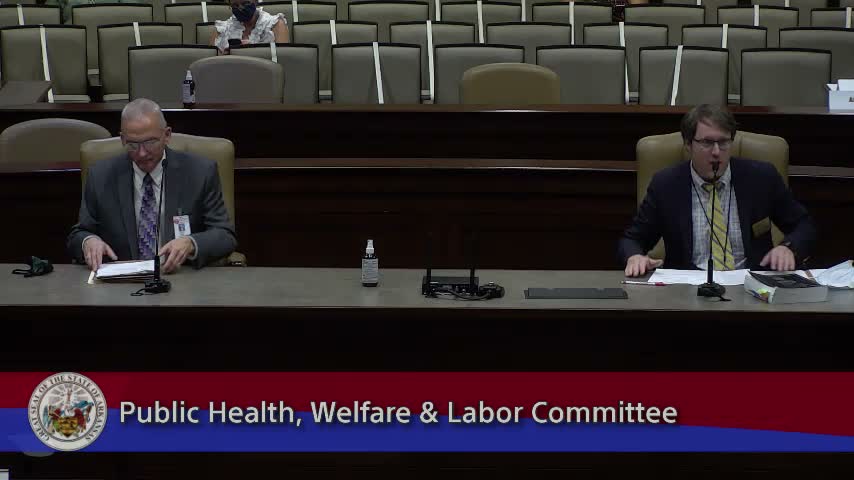
Taylor Dugan of the Arkansas Department of Education told the Senate Public Health, Welfare and Labor Committee that the agency’s rule changes formalize permission for trained public school employees to administer insulin and glucagon to students with diabetes. “What I have in front of the panel today is the rules governing insulin and glucagon administration to students with diabetes,” Dugan said.
Dugan said the changes are largely technical edits to mirror statutory language from “Act 7 57, Section 37” and that the revisions were routed through the State Board of Education and State Board of Nursing after public comment. David Dawson (general counsel, State Board of Nursing) accompanied the Department for the presentation.
Committee members asked whether schools have sufficient nursing staff. Jerry Clark, Division of Elementary and Secondary Education, said the last count he had was about 850 nurses serving public school campuses statewide and cited the recommended ratio of one nurse per 750 students. Clark said availability varies by district and that volunteer selection is typically a parent’s and school employee’s discretion.
On who may perform the tasks, the agency said volunteers must be trained by a medical professional — “trained by a medical health professional like a doctor or a nurse,” the DOE representative said — and that the program is voluntary; DOE staff indicated volunteers ordinarily would not receive additional pay for performing those duties.
The committee reviewed the rule and recorded it as "reviewed." No formal action to adopt or amend the rule was recorded in the transcript; committee discussion focused on implementation questions (staffing, training, and compensation). The committee moved on to other agenda items after Q&A.