Get Full Government Meeting Transcripts, Videos, & Alerts Forever!
Get email alerts on the Covid 19 topic
No spam. Unsubscribe anytime.
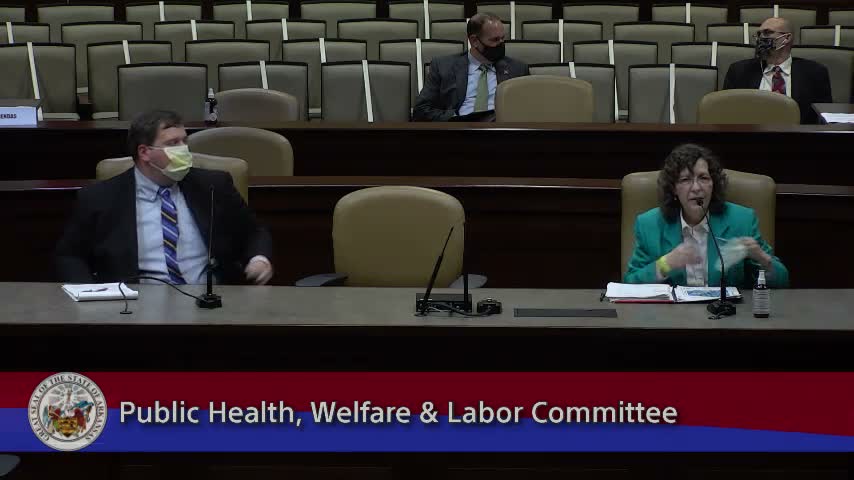
Arkansas health official reports 9,740 COVID-19 cases and outlines testing, nursing‑home plan
Summary
Dr. Jennifer Dillaha told the Senate Public Health, Welfare and Labor Committee the state had 9,740 cumulative COVID‑19 cases and 2,955 active cases; she outlined nursing‑home baseline testing, limits of antibody tests, and said ADH will work with CDC and community partners to reach Spanish‑speaking residents.
Dr. Jennifer Dillaha of the Arkansas Department of Health told the Senate Public Health, Welfare and Labor Committee that the state had recorded 9,740 cumulative COVID‑19 cases and 314 new cases reported the prior day, leaving roughly 2,955 active cases.
Dillaha said the department is continuing case investigations and contact tracing and noted that ‘‘40 to 45 percent of the cases are asymptomatic,’’ stressing that asymptomatic and presymptomatic spread make detection and control more difficult. She said that some headlines suggesting asymptomatic people ‘‘aren’t driving the spread’’ were being walked back by the World Health Organization and that ADH staff were reviewing the medical literature.
On testing strategy, Dillaha distinguished diagnostic PCR tests from antibody tests, saying PCR is the tool for identifying current infection while available antibody tests have not yet been validated and ‘‘can cross react with other coronaviruses that cause the common cold,’’ making them unsuitable to diagnose active cases. She said antibody testing could be useful later to understand how widely the virus has spread.
The department told legislators it began baseline testing in nursing homes with an initial focus on Benton County and aims to complete baseline testing by June 30 so facilities can develop safer visitation policies. ‘‘The goal is for all of the baseline testing to be completed by June 30,’’ Dillaha said, and ADH staff said guidance for periodic retesting and safe visitor procedures is being developed in coordination with the Arkansas Healthcare Association.
Lawmakers pressed ADH on apparent inconsistencies in guidance and regional reopening maps; several members urged the department to base regional divisions on hospital‑capacity maps used by health coalitions rather than the five‑region map ADH had presented. Committee leaders said they would increase the frequency of public‑health committee meetings to improve legislative feedback to ADH.
Dillaha said ADH will work with the Centers for Disease Control and Prevention to deploy a team to investigate fast‑growing outbreaks in Hispanic communities in Northwest and Southwest Arkansas and emphasized the need for Spanish‑language public‑health investigators and trusted local contacts to improve outreach. She also said the department tracks hospital bed, ICU and ventilator availability through statewide trauma‑system data and will consider ways to make capacity information more available to the public.
The committee did not take formal action on ADH recommendations at the hearing; members agreed to hold more frequent subcommittee meetings to follow up on testing, guidance conflicts and regional reopening criteria.