Get Full Government Meeting Transcripts, Videos, & Alerts Forever!
Get email alerts on the Committee Roundup topic
No spam. Unsubscribe anytime.
Senate panel advances wide slate of health, safety and administrative bills; Medicaid fraud measure clears committee
Summary
The Senate Public Health, Welfare and Labor Committee approved multiple bills in one session, including a Medicaid fraud overhaul, privacy/FOIA alignment for home‑health records, tobacco‑cessation coverage changes, peer recovery certification and other measures; several technical bills and a permissive assisted‑living waiver request also moved forward.
The Senate Public Health, Welfare and Labor Committee advanced a package of bills that its members described as a mix of technical fixes, program pilots and enforcement updates.
Among the measures that passed by voice vote were House Bill 17‑19 (Medicaid fraud unit revisions), House Bill 17‑12 (a FOIA alignment for certain home‑health records), House Bill 15‑55 (expanding Medicaid coverage of tobacco‑cessation medications without prior authorization), and a pilot authorizing DHS to test rideshare‑style nonemergency medical transport in Central Arkansas.
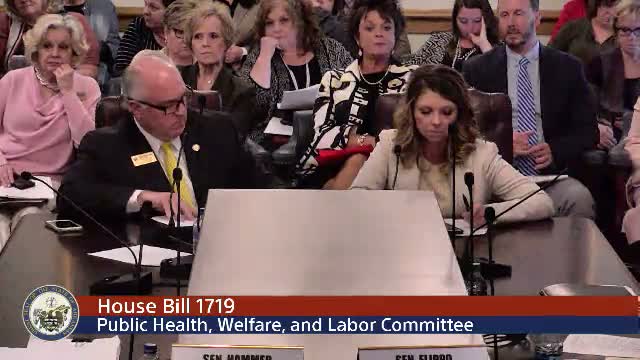
Lloyd Warford, director of the Arkansas Medicaid Fraud Unit and a deputy attorney general, summarized HB 17‑19: the bill expands the definition of false claims to include managed‑care submissions, adds misdemeanor penalties for certain neglect categories, changes civil‑penalty formulas to make them more defensible, and creates a process for returning restitution to managed‑care victims. The committee voted to recommend the bill.
Representative Dodson explained that HB 17‑12 removes a limited FOIA exception so that DHS records for home‑health functions generally follow the same public‑records rules as other health entities; the committee adopted an amendment and passed the bill.
Representative Collins said HB 15‑55 would remove prior authorization on three additional tobacco‑cessation products so all seven FDA‑approved quit aids are available through Medicaid without prior approval; the American Heart Association supported the change. DHS estimated a modest state general revenue impact (~$201,000) but did not oppose the bill.
Other bills the committee passed included measures on unclaimed identified bodies, peer recovery specialist certification for people with certain prior offenses, a blue‑ribbon pediatric cancer research panel, stronger maltreatment‑investigation language for long‑term care, and a requirement that perinatal palliative‑care options be presented to women after diagnosis of lethal fetal anomaly. Several bills were advanced with little debate; Representative Gray’s bill to statutorily fix a point‑in‑time assisted‑living minimum failed for lack of a second.
The committee adjourned with instructions that DHS will pursue any required CMS waivers for assisted‑living slot changes and return with data and fiscal estimates if CMS permits changes.