Get Full Government Meeting Transcripts, Videos, & Alerts Forever!
Get email alerts on the Sb1 Tax Package topic
No spam. Unsubscribe anytime.
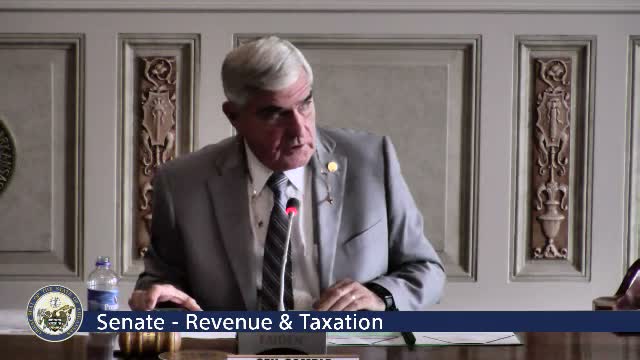
Senate panel advances bill to accelerate tax cuts, draws warnings on ARPA risk and service shortfalls
Summary
The Senate Revenue & Tax Committee voted to advance SB1, which accelerates scheduled income tax cuts, adds a one-time $150 individual credit for 2022 and aligns section 179 with federal rules. DFA said ARPA recoupment risk is minimal; advocates warned retroactivity and lost revenue would harm services and provider capacity.
Senate Revenue & Tax Committee members advanced Senate Bill 1 after a day of agency briefings and public opposition that warned about fiscal risks and service shortfalls.
Senator Desmayne, the bill sponsor, told the committee the measure "does 3 things": it creates a $150 individual income tax credit ($300 married) for tax year 2022; advances scheduled reductions in individual income tax rates (bringing the top rate to 4.9% effective Jan. 1, 2022) and lowers the corporate rate to 5.3% effective Jan. 1, 2023; and aligns the state's section 179 expense deduction with recent federal changes to aid small businesses.
The Department of Finance and Administration (DFA) described compliance steps with the American Rescue Plan Act (ARPA) and the Treasury's implementing rules. Paul Goring of DFA said Treasury-directed modeling uses a 2019 baseline adjusted for inflation and noted that recent rapid inflation raised that baseline and thus the theoretical exposure in ARPA recoupment calculations. "We made a determination ... the risk of any recoupment of the ARPA funds contemplated by this tax reduction bill ... is minimal," Goring told the committee.
Committee members pressed DFA on timing and magnitude. DFA provided examples showing the median single filer (about $26,005 in net taxable income) would see tax due fall from $888 to $523 for tax year 2022 — a $365 reduction driven in part by the $150 credit and table changes. DFA also emphasized the $150 credit is nonrefundable and applies to tax year 2022 only.
Public witnesses urged caution. Bruno Showers of Arkansas Advocates for Children and Families said making the tax cuts retroactive and accelerating them would add roughly $750 million to already projected revenue losses and remove safeguards enacted in December that were intended to freeze cuts if revenues fall. "Making the tax cuts retroactive and enacting new ones will cost an additional $750,000,000," Showers said, and he urged the legislature to prioritize investments in services rather than advancing cuts.
Dr. Sayre Devins, CEO of Arkansas Support Network and president of the Arkansas Waiver Association, testified that home- and community-based disability services remain underfunded and providers cannot recruit the direct-support workforce at current Medicaid reimbursement rates. Devins said a roughly $37 million action to clear parts of the developmental disability waiting list covers about one year of service for newly added slots but that many providers still lack staff to deliver care. "We are in dire straits and need support and assistance," Devins told the committee, urging the state to bolster provider capacity before accelerating revenue reductions.
Sponsor Desmayne closed by stressing the bill mostly advances tax cuts already on the books and that prioritization for low- and middle-income earners remains a goal. The committee took a motion to pass SB1; Senator Desmayne moved, Senator Johnson seconded, and the chair reported the motion passed after a voice vote with Senator Ingram recorded as voting no. The committee did not record a full roll-call tally in the hearing record.
The next steps are for the bill to continue through the legislative process as scheduled; staff said supplemental materials and the legal pleadings DFA reviewed would be provided to committee members for further review.