Get Full Government Meeting Transcripts, Videos, & Alerts Forever!
Get email alerts on the State Tax Policy topic
No spam. Unsubscribe anytime.
Moody's: Federal stimulus raised Arkansas revenues; proposed income‑tax changes would cut $2.6 billion over 10 years
Summary
Moody's Analytics told the Joint Senate Revenue & Tax Committee that federal stimulus narrowed pandemic revenue losses and that a proposal to consolidate income‑tax tables and lower the top rate from 5.9% to 5.5% would reduce state revenues by about $2.6 billion over 10 years while producing modest economic gains.
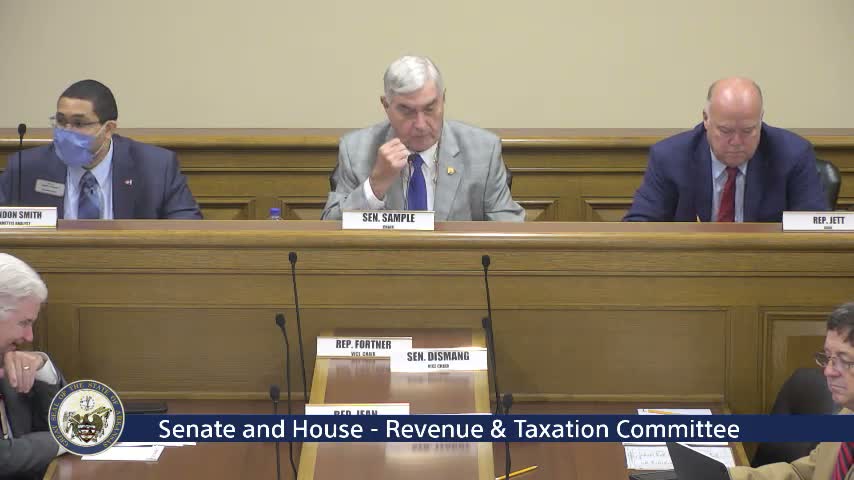
Dan White, director of fiscal policy research and public sector research at Moody's Analytics, and Emily Mandel, an economist at Moody's Analytics, told a joint meeting of the Senate Revenue & Tax Committee that federal pandemic stimulus materially changed Arkansas's recent revenue experience and that a bill to consolidate income‑tax tables and lower the top marginal rate would have measurable budgetary and economic effects.
"We estimate that without the federal stimulus, we would have been $1,100,000,000 lower in revenue, relative to where we are today," Emily Mandel said, summarizing the firm’s counterfactual modeling of sales, use and individual income tax collections during the pandemic.
Moody's presented three scenarios: actual collections, a no‑pandemic projection and a no‑stimulus counterfactual. The firm said Arkansas collected about $9.1 billion in the two revenue series across six pandemic quarters; without stimulus the state would have realized roughly $1.1 billion less in those categories. On a 10‑year horizon, Moody's said baseline revenues would be about $2.2 billion higher than a no‑pandemic growth path because of stimulus and higher nominal prices driven by inflation.
On a proposed income‑tax change, Moody's described two elements: consolidating Arkansas's low and mid tax tables into one table (reducing three tables to two) and cutting the top marginal rate from 5.9% to 5.5%. Dan White said the firm’s static estimate of the revenue cost is about $2.6 billion over 10 years beginning FY2023; Moody's' dynamic modeling narrows that to roughly $2.5 billion after feedback effects.
Moody's said the cut would simplify compliance and enforcement and that roughly half the 10‑year revenue cost would be concentrated among low‑ and middle‑income households as currently defined, with the remainder borne by taxpayers in the high table. The firm’s modeling projected that the tax cut would increase Arkansas gross state product and personal income — Moody's reported an increase in Arkansas personal income of roughly $792 million over the decade in their economic scenario — and that economic feedback would offset some but not all revenue loss.
Speakers pressed Moody's on assumptions used in the forecast. Senator Johnson asked about inflation expectations; Moody's replied that near‑term inflation is built into the baseline (peaking at an annualized quarterly rate Moody’s characterized as roughly 8–9%) and that price pressures are expected to subside toward a 2.5% annual baseline beyond FY2023–24. Representative Wootton asked whether the model counted taxes paid on the additional economic activity; Moody's confirmed feedback effects are incorporated in the dynamic analysis.
Presenters repeatedly cautioned that the economic gains shown in Moody's scenario assume the tax cut is financed from surplus revenues or reserves; if the state compensates the cut with spending reductions, layoffs or other cuts, Moody's said the modeled economic benefits would be smaller or eliminated. Several members cited the importance of Arkansas' reserve policy and a proposed 20% set‑aside to provide a backstop; Moody's said its stress tests find typical median states need 13–18% of budget in reserves to weather two years of downturn and 20–25% for more severe scenarios.
No formal motion or vote occurred. The committee closed after questions and adjourned.