Get Full Government Meeting Transcripts, Videos, & Alerts Forever!
Get email alerts on the Sales Tax Exemption topic
No spam. Unsubscribe anytime.
Committee hears industry testimony on bill to exempt coins, bullion and currency from sales tax
Summary
Senate Bill 336, introduced by Sen. Mark Johnson, would exempt certain coins, bullion and currency sold for their intrinsic or collectible value from Arkansas sales tax. Industry witnesses argued the exemption would boost shows, dealers and tourism; DFA projected a state sales-tax loss of about $766,000 in the first fiscal year and roughly $1.15 million under an annualized scenario.
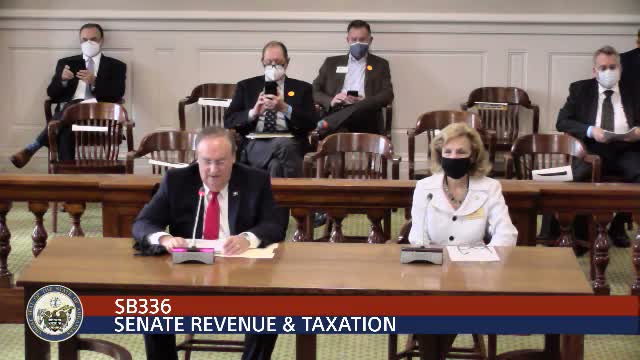
Senate Bill 336 was presented by Senator Mark Johnson (District 15). Johnson said the bill would treat gold, silver, bullion and certain coins and currency as investment commodities rather than taxable tangible personal property, aligning Arkansas with many other states.
"It's a very simple bill in that it treats gold, silver, bullion, and and and currency as a commodity that it is and not a, tangible personal property that should be subject to sales tax," Johnson said during his introduction. He brought physical examples of bullion to the committee for a show‑and‑tell.
Patrick Heller, a Lansing, Michigan coin dealer and CPA by training, testified that states adopting exemptions saw increased dealer activity, more trade shows, higher payrolls and ancillary tax revenue. He gave a concrete example: "2 days ago a customer that lives about 25 miles from my store sent us a bank wire for $525,000 to buy gold. Our company's margin on the transaction is $7,800. Had that been subject to Michigan sales tax, the sales tax would be 31,500 which means that customer would never have bought the merchandise from our customer." Heller and other witnesses told the committee dealers and shows relocate to states with exemptions, reducing Arkansas tourism and local business receipts.
Committee members asked detailed questions about statutory definitions: what constitutes "intrinsic" metal value, when collectible value overrides intrinsic value, and whether coins or bars altered into jewelry or household items would be taxable. Senator Desmond summarized the tension: "I think what I understood the testimony to be was is that collectible would be subject to sales tax. It's the gold or silver or whatever it is that would not be." Witnesses and the sponsor acknowledged gray areas and said they would work on clearer definitions.
A DFA fiscal analyst presented projected tax losses tied to the measure: "The projected sales tax loss in the first fiscal year ... would be approximately $766,000 in state sales tax and approximately ... $255,000 in local sales taxes for a full year of collections." The DFA official also gave an alternative annualized estimate of about $1,150,000 in state sales-tax loss and about $383,000 in local loss, and offered to answer questions about methodology.
Senator Johnson closed the hearing by saying he would work with DFA and stakeholders to refine definitions before bringing the bill back for a committee vote.
Next steps: sponsor to revise statutory language addressing the collectible/intrinsic-value boundary and return for further consideration; no committee vote recorded at this hearing.