Get Full Government Meeting Transcripts, Videos, & Alerts Forever!
Get email alerts on the Taxation Car Wash Fee topic
No spam. Unsubscribe anytime.
Senate committee hears bill to repeal car-wash water-usage fee; DFA neutral, bill not voted
Summary
The Senate Revenue & Tax Committee heard Senate Bill 9 to repeal the car-wash water-usage fee enacted by Act 822 of 2019. DFA said repeal would remove the fee (roughly $670,000 impact this year, about $1.0M annually) but leave earlier sales-tax exemptions intact; no final vote was taken.
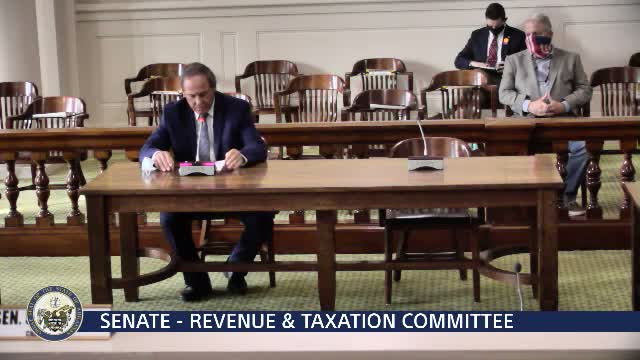
The Senate Revenue & Tax Committee on Thursday heard Senate Bill 9, a measure to repeal the car-wash water-usage fee created by Act 822 of 2019. Sponsor Senator Stubblefield said the fee produced confusion for operators who share one water meter among multiple businesses and argued the car-wash charge should be considered as a standalone item rather than bundled into a larger tax bill.
Greenwood convenience-store owner Wade Dunn told the committee that his location— which includes manual wash bays, an automatic bay and a laundromat—was forced to "estimate" water usage under DFA guidance. "It's just a guess at best," Dunn said, describing efforts with DFA to calculate usage (he and staff settled on 50 gallons per wash) and saying the requirement was impractical when multiple businesses share one meter.
Paul (identified in the record as Paul Garing and later as Paul Gehring) of the Department of Finance and Administration (DFA) told senators SB9 would remove only the water-usage fee enacted by Act 822 of 2019 and would not repeal the sales-and-use tax exemptions in that act for tangible personal property and certain services used in car washes. "This bill only touches upon and removes the car wash water usage fee," Paul said. He recalled wider revenue estimates tied to the 2019 exemptions in the neighborhood of $2–$3 million in sales-tax losses, but said those exemptions would remain if SB9 became law.
DFA provided a fiscal estimate for the fee: full-year collections previously were about $1,000,000; because SB9 would affect roughly eight months of collections this fiscal year, DFA estimated a $670,000 impact for the current year. DFA said it would remain neutral on the bill and provide fiscal information if requested.
Committee members pressed on technical and administrative questions. Senators and DFA staff discussed alternatives to meter-based measurement—staff said earlier drafts considered a per-bay or flat fee based on number of bays, and DFA recalled that during rulemaking it recommended (but did not require) operators install a separate meter for automatic bays. Wade Dunn estimated a separate meter would cost about $200 plus installation, but members noted additional plumbing complications where multiple internal lines, hot-water heaters and reverse-osmosis systems make isolation of an automatic-bay meter challenging.
Several senators expressed concern about taking tax cuts early in a session, and about the committee's broader approach to revenue estimates and DFA's decision to be neutral on this measure. DFA officials said their neutrality reflected administrative costs and the scale of revenue involved rather than a policy stance on car-wash taxation.
The committee adopted its internal rules by voice vote during the same meeting. The committee took no final vote on Senate Bill 9 and the chair said the bill would be called back later in the session for a vote when the committee has clearer information on available revenue.
What happens next: Senate Bill 9 was heard but not voted on; DFA will provide additional fiscal detail if requested and the sponsor may return the bill for a future committee vote.