Get Full Government Meeting Transcripts, Videos, & Alerts Forever!
Get email alerts on the Unemployment Tax Exemption topic
No spam. Unsubscribe anytime.
Senate panel advances bill exempting state income tax on unemployment for 2020–2021
Summary
The Senate Revenue & Taxation Committee voted to advance Senate Bill 236, which would exempt state income tax on unemployment benefits for calendar years 2020 and 2021. DFA testified the measure reduces taxpayer uncertainty during filing season and estimated a potential FY21 revenue impact of about $51 million.
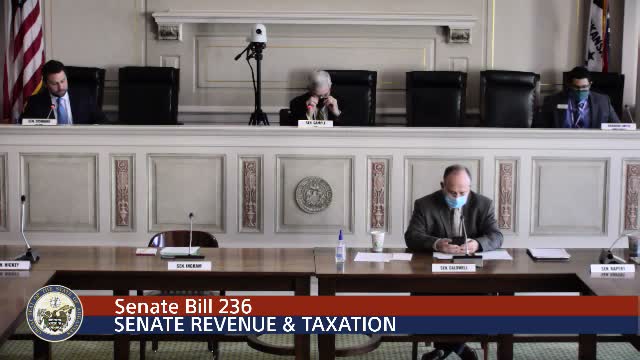
The Senate Revenue & Taxation Committee on the floor advanced Senate Bill 236, a measure that would remove state income tax on unemployment benefits for calendar years 2020 and 2021 to address pandemic-era filing and administrative issues.
Sponsor testimony said the bill is intended to reduce taxpayer confusion after a spike in unemployment claims and the issuance of 1099 forms. "What this bill does, it removes the unemployment state income or state income tax on unemployment for the calendar years, 2020 and 2021," the sponsor told the committee. Committee members underscored urgency because tax season was beginning and many taxpayers had already received 1099 forms.
Paul Gehring, assistant revenue commissioner at the Department of Finance and Administration, and Paul Lothian, DFA deputy director, testified in favor and outlined DFA's revenue estimate. Lothian said DFA received Department of Workforce Services data showing roughly $2,600,000,000 in unemployment benefits reported on 1099s for the 2020 filing year, and applied a historical 65% reporting rate and a 3% effective tax rate to arrive at a potential FY21 impact of about $51,000,000. "We applied that 65% filing rate to that 2,600,000,000, which came up with about 1,700,000,000 that we would potentially expect to be received," Lothian said.
Members pressed how the state would treat fraudulent unemployment claims and mistaken 1099s. The sponsor and DFA officials said workforce services will issue corrected 1099s (including "0" reporting forms) for claims where no funds were actually paid, and that federal tax issues remain separate from the state exemption. The sponsor said corrected forms should alleviate many recipients' immediate state tax concerns: "There will be corrected 1099 sent out, for those who didn't actually receive unemployment compensation," the sponsor said.
Several senators asked whether the relief could be more narrowly targeted—for example, by excluding higher-income recipients or establishing a refundable credit—but DFA cautioned that a credit-based approach would require more programming changes, create administrative burden, and likely require affected taxpayers to file returns to claim the credit. Committee members emphasized the bill is designed to be a time-sensitive fix to reduce confusion in the current filing season; broader debates about the taxation of unemployment generally, they said, can be pursued later.
After discussion, the committee voted to suspend the usual waiting rule and took a voice vote to advance the bill. The committee recorded the motion to suspend the rules as carried and subsequently approved the motion to 'do pass.' The panel then moved on to other agenda items.