Get Full Government Meeting Transcripts, Videos, & Alerts Forever!
Get email alerts on the Committee Roundup topic
No spam. Unsubscribe anytime.
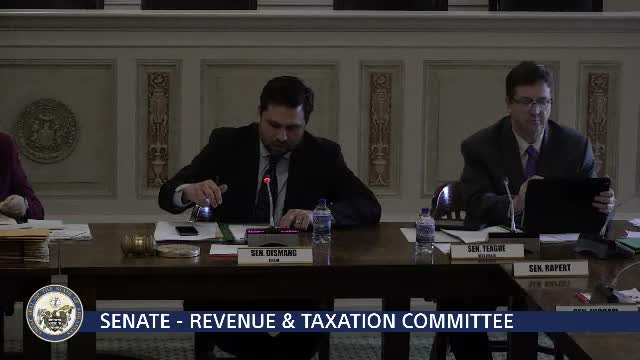
Senate Revenue & Tax Committee advances technical and administrative tax bills; ABLE-account deduction and lien publication pass
Summary
The committee unanimously or by voice vote approved a series of tax and administrative bills: HB 1800 (historic rehabilitation credit structure), HB 1075 (ABLE-account deduction), HB 1618 (rural fire extractor requirement), HB 1724 (DFA hearing discretion), HB 1910 (tax-lien publication), HB 1908 (amended returns clarification), HB 1931 (procurement notice for closed businesses), and HB 1953 (federal conformity).
The Senate Revenue & Tax Committee approved a stack of bills covering tax credits, administrative procedure and conformity to federal tax rules.
House Bill 1800 would create a historic rehabilitation tax credit for projects larger than the state’s current $1.5 million cap; sponsor Representative Andy Davis said the mechanism matches the existing credit and that funding would come from grants, donations or transfers rather than an immediate appropriation. The committee voted to place the bill on the calendar and then approved Do Pass.
House Bill 1075 would allow an income-tax deduction — not a credit — for contributions to ABLE accounts used by and for people with disabilities. Grant Wallace, chief deputy treasurer, said the program had 245 accounts with $140,700 in assets and an average balance of $574; Arkansas’s proposal would align with a $5,000 deduction that several other states allow. The committee approved the bill.
House Bill 1618, addressing rural fire departments’ requirement to acquire high-speed extractors to remove carcinogens from turnout gear, was advanced after sponsors described a fiscal impact of about $20,000 reported in the House.
House Bill 1724 gives the DFA director discretion to conduct administrative hearings electronically while preserving in-person and telephonic options at satellite offices; presenters said there would be no fiscal impact. House Bill 1910 authorizes DFA to publish active tax liens (certificates of indebtedness) prospectively in a searchable DFA database and to remove entries when liens are released; DFA said the service is intended to be a single point of contact for taxpayers and closing companies and that liens would not be posted while administrative disputes are ongoing.
House Bill 1908 clarifies when taxpayers may file amended returns and leaves existing time limits intact (three years from filing or two years from payment), a point Joel DePiper, DFA revenue counsel, explicitly told the committee: “This does not change anything... We are not taking away anyone's ability to get a refund of overpaid tax.”
House Bill 1931 adjusts procurement procedures to allow procurement officials to stop doing business with contractors subject to final closure orders for tax noncompliance, while preserving the opportunity for businesses to remedy problems and return to procurement lists. House Bill 1953 is a technical conformity bill adopting select changes from the Internal Revenue Code into Arkansas law; sponsors outlined a set of line-item fiscal effects intended to harmonize state and federal calculations and reduce programming burdens for tax software.
All of the above measures were approved by the committee and will be reported out for further consideration, except where a formal roll call or final floor action is required later in the process.