Get Full Government Meeting Transcripts, Videos, & Alerts Forever!
Get email alerts on the Tax Omnibus topic
No spam. Unsubscribe anytime.
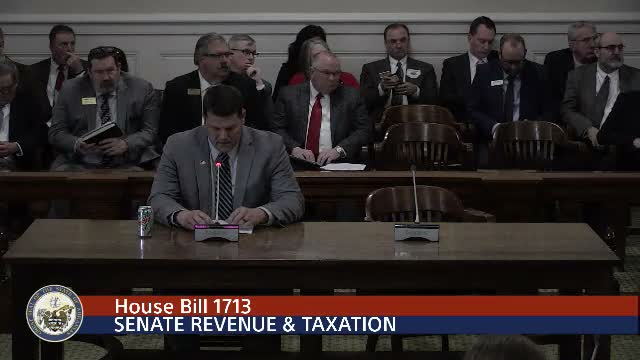
Senate committee passes broad tax reform package with corporate rate cuts, online-sales collection and new car-wash rules
Summary
The Senate Revenue & Tax Committee voted to pass an amended omnibus tax bill that reduces the corporate income tax rate in stages, adopts single-sales-factor apportionment, extends net operating loss carryforwards and authorizes online sales tax collections; a disputed car-wash water‑use provision drew extensive public opposition.
The Senate Revenue & Tax Committee on a voice vote approved an amended omnibus tax bill (Senate Bill 576) that would reduce Arkansas’s top corporate income tax rate in two steps, move corporations to a single-sales-factor apportionment, extend net operating-loss carryforwards and authorize collections of online use tax.
Sponsor Bart Hester told the committee the bill is designed to make Arkansas more competitive for business. "We worked through the tax reform task force," Hester said, summarizing the package as an effort to lower overall rates and attract investment.
The amendment adopted in committee reduces the corporate rate from 6.5 percent to 6.2 percent in 2021 and to 5.9 percent in 2022, keeps the existing throwback rule in place (removing an earlier repeal), and extends the net operating loss carryforward period from five years to ten. DFA economist Paul Gehring told members the handout he provided shows the full phase‑in fiscal effect of the corporate rate change and that the department will update its fiscal impact statement if the amendment is adopted into the bill.
The bill also includes a marketplace‑fairness provision to collect online sales tax, timed to be effective for 11 months of collections in the fiscal year if enacted July 1; Gehring projected roughly $32.4 million in state sales tax for the partial year and $35.4 million in FY '21 under the proposed collection. Gehring said roughly 80 percent of the additional collections are projected to come from marketplace sellers.
A controversial portion of the bill changes how car-wash sales are treated. The amendment creates a water‑use tax for certain tunnel car washes and establishes flat annual fees for other car-wash types (for example, $500 for certain automatic washes and $100 per self‑serve bay); proponents framed it as an attempt to replace an inconsistent patchwork of exemptions.
Sam Neely, chief financial officer of Zipcar Wash LLC, urged lawmakers to pull the car‑wash language for more study. He provided company estimates that the proposed water tax would amount to roughly $38,728 per tunnel location per year and said that, for his 16 Arkansas locations, the company would face nearly $620,000 annually before offsetting exemptions. "This bill creates a new state tax on water usage," Neely said, arguing the proposal would treat tunnel operators very differently than automatic or self‑serve outlets.
Retail and small‑business groups urged the committee to adopt the online‑sales provision and the business tax changes. Jeff Beacham, a small retail business owner, and Randy Land of the Home Furnishings Association said state collections would level the playing field for brick‑and‑mortar sellers; Matthew Bach and Randy Zug, representing the Arkansas State Chamber, told the committee the package would substantially improve Arkansas’s competitiveness.
Proponents and DFA acknowledged the package’s fiscal complexity and uncertainties. Gehring described ranges in the car‑wash estimate (a net impact range of about $800,000 loss to $1.2 million loss for the car‑wash components depending on assumptions) and said the department will issue an updated fiscal impact statement to reflect the amendment.
The committee passed the amended bill after extended discussion and public testimony. The measure now moves on the legislative process with the details of fiscal estimates to be finalized by DFA.