Get Full Government Meeting Transcripts, Videos, & Alerts Forever!
Get email alerts on the Dfa Revenue Report topic
No spam. Unsubscribe anytime.
DFA presents December revenue report; lawmakers ask about severance tax decline and taxation of internet audio calls
Summary
Paul Goring of DFA and Richard Wilson presented a December revenue report showing Arkansas collections ahead of last year and slightly ahead of the revised forecast; senators asked DFA to follow up on a decline in natural gas severance tax allocations to counties and requested a study into whether internet/VoIP audio calls ("Facebook audio") are being captured for taxation.
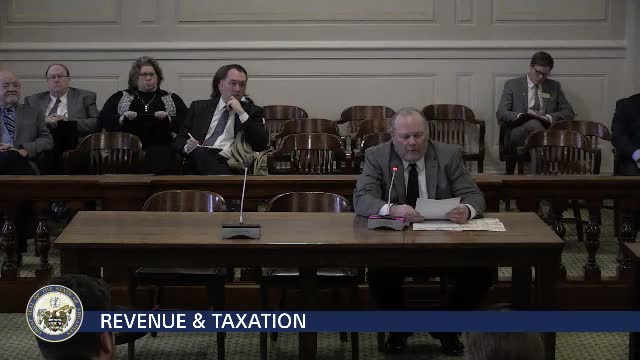
The Department of Finance and Administration presented a December revenue report to the Senate Revenue & Tax Committee showing the state is ahead of collections from the same six‑month period last year and modestly ahead of the revised official forecast.
"On a gross collections basis, we're currently $137,600,000 ahead of the same six‑month period last year," Richard Wilson reported, and he said net collections were $163,200,000 ahead, with an annualized net growth rate of about 6.1 percent. Wilson also noted the state was $17,000,000 ahead of the November 14 revised official forecast after two months.
Paul Goring of the Arkansas Department of Finance and Administration explained how DFA prepares fiscal impact statements (often called "green sheets"): DFA reviews every bill filed daily, assigns administrators and revenue legal counsel to produce a summary, estimated revenue impact, notes on administrative resources required, procedural observations and legal analysis, and then transmits the finalized statement to the Bureau of Legislative Research for posting on the bill's BLR page.
Goring emphasized methodological limits: DFA's revenue estimates are "static in nature," he said, meaning they account for the estimated effect of a bill on the state's budget without modeling future behavioral or macroeconomic changes that might result from a policy change.
Senator Rayford asked for clarification on a percentage decrease shown for a natural gas severance tax line in the report and whether off‑the‑top distributions to counties explained the decline. DFA said it would consult the severance‑tax administration team and provide an update.
Rayford also raised a separate concern about internet/VoIP audio calls: describing an incoming "Facebook audio" call while driving with no Wi‑Fi, he said the call produced no record and "there is no tax on that." He asked DFA to study whether that class of traffic should be captured for user fees or telecommunications taxes; DFA offered to look into the matter and report back.
The committee did not take formal action on any tax policy changes at the meeting; DFA was asked to follow up with more detail on severance‑tax allocations and the potential scope for taxing internet/VoIP audio calls.