Get Full Government Meeting Transcripts, Videos, & Alerts Forever!
Get email alerts on the Housing Policy topic
No spam. Unsubscribe anytime.
Senate committee debate delays bill that would limit local residential design rules amid concerns for home-rule and downtown districts
Summary
Senate Bill 170, which would restrict cities and counties from imposing certain residential design elements (materials, roof pitch, porches) seen as increasing housing costs, prompted extended debate over home rule and exemptions for historic and central-business districts; the committee took no vote and postponed further action to Thursday.
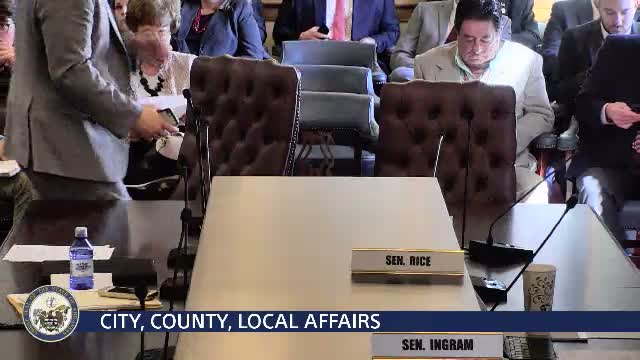
Senate Bill 170, introduced by Senator Hester, drew extended discussion in the City, County & Local Affairs Committee. Sponsors presented the bill as a measure to protect low- and middle-income homebuyers from local regulations that can add substantial cost to new housing, while opponents warned the language could strip local governments of legitimate planning authority.
Josh Carson, executive vice president and general counsel for Rausch-Coleman Homes, said developers and homebuyers have seen design requirements increase construction costs, sometimes by "10 to $20,000 a home," and argued the bill would prevent municipal ordinances from pricing first-time buyers out of the market. "Let builders build, let buyers buy," Carson said, urging senators to prevent restrictive local design mandates.
Opponents on the committee, including Senators Flowers, Clark and Ingram, raised concerns that the bill would erode home rule and could interfere with urban-renewal plans or Central Business Improvement Districts (CBIDs) that manage downtown development. Senator Flowers asked why the bill exempts CBIDs and historic districts; sponsors said the exemptions were intended to preserve urban design programs while protecting single-family residential areas.
Senators also discussed whether the federal Fair Housing Act and existing local processes already address discriminatory design practices. Chris Lines from the Association of Arkansas Counties said the bill affects "a broader segment of government" than simply quorum-court procedural changes and that counties and cities could be differently affected.
The committee did not vote on SB170 and agreed to continue the matter at the next meeting Thursday, allowing members more time to review the bill text and receive input from municipal representatives and stakeholders.