Get Full Government Meeting Transcripts, Videos, & Alerts Forever!
Get email alerts on the Rule Packets Dhs Dcfs topic
No spam. Unsubscribe anytime.
Committee reviews multiple DHS/DCFS rule packets: childcare licensing, CAPTA referrals, trial home placements, subsidized guardianship and registry rules
Summary
Committee reviewed and voted to review/approve multiple rule packets updating minimum childcare licensing (Act 530), CAPTA‑related referrals for infants affected by prenatal drug exposure, trial home placement rules, expansion of subsidized guardianship to fictive kin, and procedural central registry review requirements under Act 802. Members asked questions about background check automation, funding and guardianship usage.
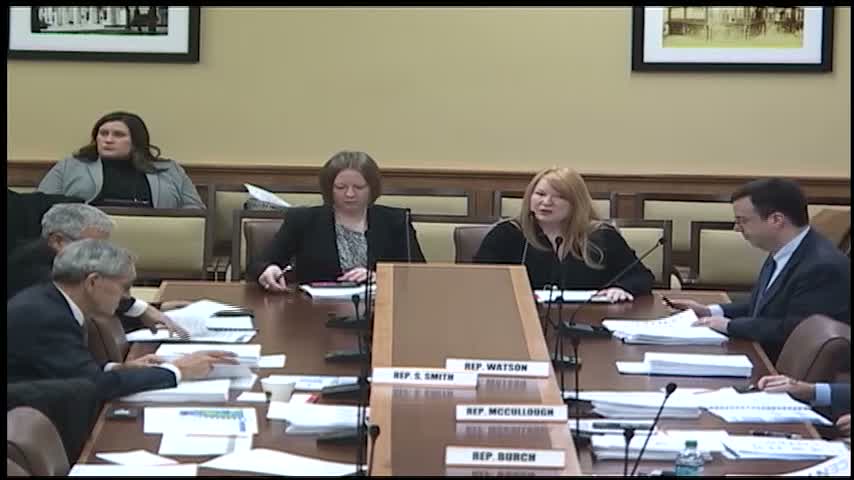
The Senate Children and Youth Committee reviewed several rule packets filed by DHS and DCFS to align department policy with statutory changes enacted in the 2019 regular session and federal guidance.
Childcare licensing (Exhibit D): Mark White, Ashlyn Abney and Kelly Hilburn described updates to minimum licensing requirements driven by Act 530 of 2019 and the federal Child Care and Development Block Grant (CCDBG). The changes explicitly add child‑maltreatment mandated‑reporter language, expand criminal background check and job‑training references and add disaster‑preparedness expectations. Committee members asked about a provision that currently requires prospective staff to wait for Arkansas State Police background checks (which can take up to 30 days); Abney said DHS expects an automation rollout with the State Police in mid‑January to shorten turnaround times. The committee reviewed and carried D, D‑1, D‑2 and D‑3 by voice vote.
CAPTA referrals for infants affected by prenatal drug exposure (Exhibit E): Kristen Harper presented a packet implementing federal CAPTA changes and Act 598. The rule allows health‑care providers involved at delivery to call the child‑abuse hotline when an infant is affected by prenatal exposure to legal drugs; those reports do not automatically trigger maltreatment investigations but prompt DCFS to meet families, assess needs and develop a safe‑care plan. Harper said responses to infants or mothers who test positive for illegal substances at birth (Garrett’s law responses) remain unchanged. The committee reviewed Exhibit E.
Permanency and trial home placements (Exhibit F): Harper said the packet implements Act 541 and Act 558 changes to allow trial home placements with noncustodial parents and clarifies supervised‑visitation minimums ordered by the court (four hours per week unless otherwise ordered). The rule allows provisional foster placements with appropriate, safe noncustodial fathers prior to court custody adjustments; the committee reviewed Exhibit F.
Subsidized guardianship and fictive kin (Exhibit G): DCFS updated subsidized guardianship policy per Act 968 to expand the definition of "relative" to include "fictive kin" (people with a strong emotional tie to the child, such as teachers, coaches or pastors) solely for determining guardianship subsidy eligibility. Harper told the committee there are 59 active guardianship cases involving 103 children and estimated about 65% of children are IV‑E eligible on a rough monthly average. Members raised funding concerns; Harper said title IV‑E funding is available for many guardianships and that low utilization historically stemmed from staff education gaps as well as other factors. The committee reviewed Exhibit G.
Central registry and administrative closure procedures (Exhibit I): The final packet (Act 802 implementation) revises procedures and secondary‑review requirements for maltreatment reports, administrative closures and maltreatment investigations. It also requires staff to determine whether an offender poses a risk to vulnerable populations before placement on the Child Maltreatment Central Registry and gives the DCFS director responsibility to approve administrative closures and "no risk" exemptions. The committee reviewed Exhibit I.
Process note: Senator Clark asked that members retain the right to request that any rule packet be pulled back to this committee before Administrative Law Committee review if concerns surface; the committee carried that procedural motion. All presented exhibits were reviewed by voice votes during the meeting; no new funding measures were adopted during the session.
What’s next: the rule packets will proceed to ALC and then the rules and regulations process as required by statute.