Get Full Government Meeting Transcripts, Videos, & Alerts Forever!
Get email alerts on the SB8 Child Image Restrictions topic
No spam. Unsubscribe anytime.
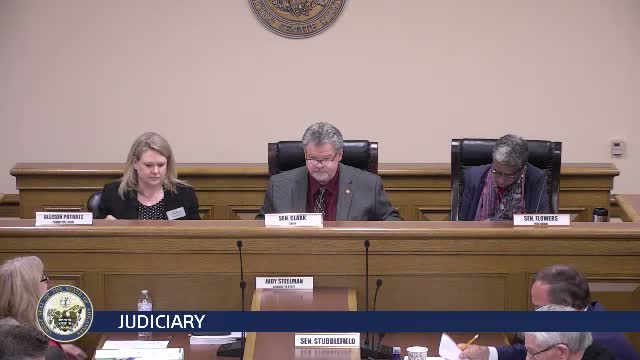
Senate Judiciary Committee hears SB 8 to bar some registered sex offenders from posting or using images of children online; debate centers on scope and drafting
Summary
Sponsors say SB 8 would bar level 3 and 4 registered sex offenders from recording or using images of children under 14 on social media; opponents warned the bill is overbroad and may raise constitutional problems and unintended employment consequences. The committee adopted a technical wording change and continued the bill for further work next week.
Senators on the Judiciary Committee debated SB 8, a bill sponsored on the floor to prohibit level 3 and level 4 registered sex offenders from recording children under 14 or using a child’s image on social media without a guardian’s permission. Sponsor Senator Garner said the measure responds to incidents in other states where registrants posted images of minors online and argued the change would protect children’s images and reduce predators’ ability to ‘catfish’ victims.
The bill’s sponsor told the committee that SB 8 would “prevent them from taking recordings ... of children under the age of 14 unless they have the permission of the guardian or parent” and that the measure would also address “using the social media image on social media.” He added, “If we pass this law, it will help prevent our children's image from being used in such a disgusting and terrible fashion.”
Committee questions focused on drafting clarity and constitutional risk. Senator Ballinger raised a concern that the bill’s exception language—allowing use of an image with parental permission—might be read to create unintended exceptions because of punctuation and conjunctions in the text; members agreed to a technical correction on committee motion, changing an instance of “or” to “and” to tighten the exception language. Senator Cooper asked whether the phrase “in any form” modifies the recording or the platform; the sponsor said it was intended broadly to capture websites and platforms that allow posting in any form.
Witnesses in public comment urged caution. Carla Swanson of Arkansas Time After Time warned that routine photography at public events (for example, a soccer game) could be swept up by the language and questioned how enforcement against private downloading or offline possession would work; she also said, “95 percent of all sex offenders do not reoffend,” urging members to weigh that statistic in deciding policy. Jeff Rosenzweig of the Arkansas Association of Criminal Defense Lawyers testified the bill is “wildly overbroad,” arguing the definition of “record” could reach historical photos, newspaper images or private possession and cited the U.S. Supreme Court decision Packingham v. North Carolina as precedent that limits broad internet restrictions on registrants.
Sponsor Senator Garner and supporters said the bill targets online posting and the creation or use of images for predatory purposes and that narrow drafting changes could address concerns. The committee made a technical correction on the text and voted that correction by voice vote. With time running, members agreed to continue the hearing on SB 8; the chair scheduled further consideration next Wednesday at 10:00 a.m.
Next steps: SB 8 was continued for additional drafting and testimony; the committee did not take a final vote on the bill at this meeting.