Utah Avalanche Center asks state for $1 million toward AI‑assisted forecasting prototype
November 01, 2024 | Utah Outdoor Adventure Commission, Utah Department of Natural Resources, Utah Government Divisions, Utah Legislative Branch, Utah
This article was created by AI summarizing key points discussed. AI makes mistakes, so for full details and context, please refer to the video of the full meeting. Please report any errors so we can fix them. Report an error »
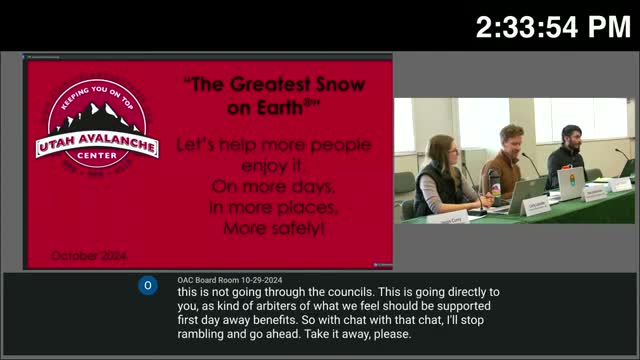
Chad said the UAC’s proof of concept found strong correlations between machine‑generated snow profiles and human observations and that model instability scores over roughly 0.7 corresponded with a significant number of recorded backcountry avalanches. He described anticipated benefits: reducing the forecaster time required to prepare a daily forecast, expanding forecast reach into three underserved regions, and producing public safety and search‑and‑rescue benefits.
"When the model showed over about 0.7, we had a significant number of backcountry avalanches," Chad said, summarizing correlation results from validation work. He added that machine processing could free forecasters to focus on communicating safety information to the public.
Chad provided a prototype budget and funding plan: a total project cost of about $2,700,000 to buy weather instrumentation, build a dashboard, expand data systems, and fund modeling work; UAC requested $1,000,000 (about 35% of the total) from the commission, with remaining costs expected from corporate partners, federal grants and donor support.
Commissioners asked how an AI‑driven forecast would be presented to the public and whether disclaimers would be needed where human oversight is limited. Chad said those operational questions remain to be worked out and that the initial prototype would be an internal tool for forecasters; if successful, parts of the system could later inform public products.
Why it matters: expanding forecasting coverage and improving early detection could provide more timely safety information to backcountry users, reduce strain on search‑and‑rescue organizations and support underserved forecast regions in the Eastern Uintas, Oquirrh (Ochre) Mountains and Tusher Mountains, the UAC said. Commissioners did not take a vote; staff said the request will be considered along with other presentations at the November meeting.
View the Full Meeting & All Its Details
This article offers just a summary. Unlock complete video, transcripts, and insights as a Founder Member.
30-day money-back guarantee
Sponsors
Proudly supported by sponsors who keep Utah articles free in 2026

Excel Chiropractic

