Get Full Government Meeting Transcripts, Videos, & Alerts Forever!
Get email alerts on the Sales Tax Renewal topic
No spam. Unsubscribe anytime.
Gardner council directs staff to pursue February mail ballot on renewing half-cent infrastructure sales tax
Summary
City Engineer Tim McEldowne presented a 10-year pavement plan and cost estimates; councilmembers expressed broad support for renewing the existing half-cent Special Infrastructure Sales Tax and asked staff to prepare ballot language and a resolution for the next meeting, targeting a February vote.
Gardner 'City Engineer Tim McEldowne told the City Council at a work session that the city's half-cent Special Infrastructure Sales Tax has funded pavement, curb, sidewalk and trail work since voters approved it in February 2005 and that the current authorization is set to sunset on Dec. 31, 2025.
"In the last nine years, we've averaged about $1,400,000 in revenue per year," McEldowne said, noting the most recent year brought $1,600,000. He described roughly $11.9 million in prior program spending, including about $5.8 million on pavement management and $4.8 million on curb and gutter replacement.
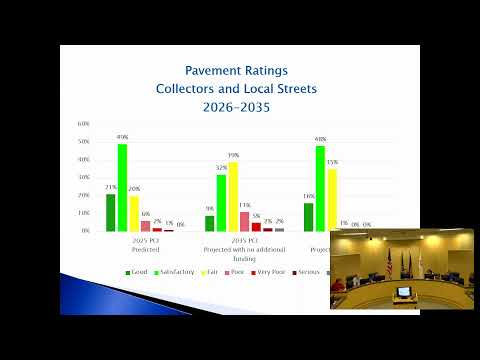
McEldowne presented PAVER modeling and a three-scenario projection: a do-nothing forecast that shows significant deterioration, a scenario that holds current condition roughly steady with continued maintenance, and a scenario that spends all projected revenue on roads. He said staff estimates a 10-year maintenance-only program would require about $9.0 million, with an additional $3.0 million to address the worst concrete replacements. Planned trail work and ADA upgrades add about $3.3 million ($2.8 million to replace asphalt trails with concrete and $0.5 million to fill trail gaps), creating a combined 10-year estimate of about $15.9 million against an expected revenue of $16.0 million over the same period.
Council discussion focused on timing, turnout and long-term needs. Members debated February mail-ballot timing (the preferred option to meet election-office windows) versus alternatives such as placing the measure on an August or November ballot. Councilmembers noted the program covers local and collector streets but not arterials, which will require separate funding sources such as grant programs, bonds or a future ballot question.
Several councilmembers said the half-cent rate is the minimum needed to maintain current pavement condition; some urged study of higher rates for longer-term needs but cautioned that raising the amount may reduce voter support. A communications staff member noted the previous renewal passed with 63% approval and outlined outreach plans including a November newsletter, mailers, social media and open houses.
There was no formal roll-call vote during the work session. Council consensus directed staff to prepare ballot language and bring a resolution at the next regular meeting to set an election (staff said they would confirm exact dates and ballot deadlines with the Johnson County Elections Office). One councilmember noted an internal deadline staff had mentioned to them for materials.
What happens next: staff will draft ballot language and a resolution for council consideration at the next meeting, confirm election dates with the county elections officer and begin a public information campaign ahead of the targeted February election window. If the council chooses to pursue arterials or a larger funding package, members indicated that would likely be the subject of a separate discussion or future ballot measure.
Why it matters: the renewal decision determines funding for maintenance that staff said has kept most streets at "fair or better" but has not restored a pre-program goal of a majority of streets in "good" condition. Council members framed the decision as a choice between maintaining current service levels via the sales tax or shifting to property tax or larger future measures to address arterial and replacement needs.