Get Full Government Meeting Transcripts, Videos, & Alerts Forever!
Get email alerts on the Public Health topic
No spam. Unsubscribe anytime.
Yuma County health director outlines services and warns of grant uncertainty
Summary
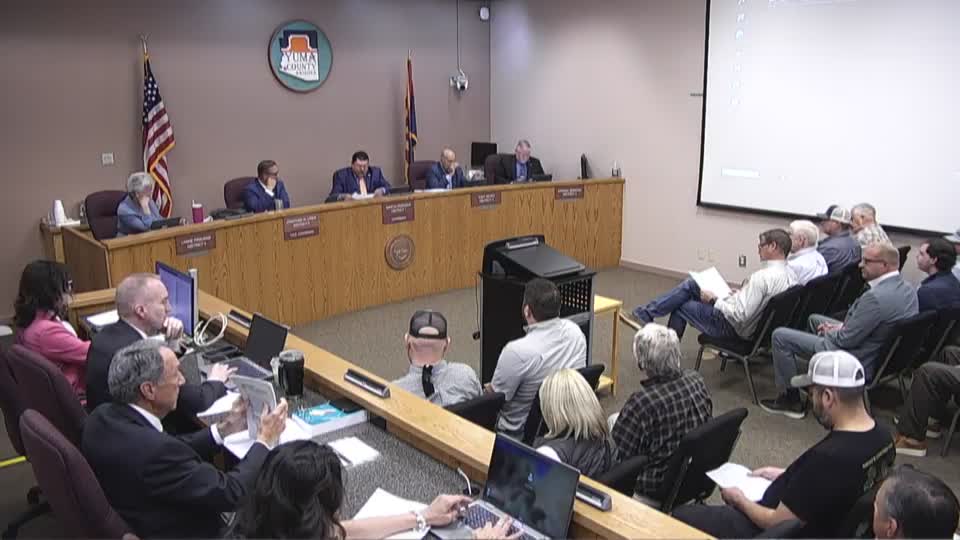
Public Health Director Diane Gomez told the Board of Supervisors on March 24 that the county’s health department provides wide-ranging services — from WIC and immunizations to fatality reviews and cooling centers — and that roughly 40% of programming relies on federal grants that may be unstable, potentially forcing program cuts or fee increases.
Diane Gomez, director of the Yuma County Public Health Service District, gave the board an overview of the department’s programs on March 24, emphasizing both routine services and less-visible operations that support county residents. Gomez said the department handles birth and death certificates, WIC nutrition services, maternal-child programs (including Health Start), infectious-disease surveillance and response, opioid and suicide fatality reviews, environmental-health inspections and vector control, and emergency preparedness and medical reserve corps support.
Gomez told supervisors that the department combines district funding with grant dollars to deliver services widely used in the community. She said approximately half of operations are covered by district funds and that “about 40% is federal grants,” calling attention to recent federal funding notices that briefly told grant recipients to stop work and then rescinded that directive. She warned that because many grants operate on a reimbursement model — counties and subcontractors perform work first and bill later — a pause or rescission can expose local partners to short-term liability.
Board members pressed for specifics about which programs would be at risk. Gomez said federally funded programs include many of the community‑education and outreach efforts, maternal‑child health and chronic‑disease work, and the WIC nutrition program. She noted the department also runs community immunization events, cooling‑center coordination for heat resilience, and partnerships with universities and local non‑profits to extend services to farmworkers and rural residents.
Gomez described local efforts to plan for uncertainty: the department is actively pursuing additional federal funding, developing contingency plans and relying on academic and nonprofit partners to deliver services where possible. “When you look at, for example, CDC funding, 80% of that funding eventually makes it down to the local levels,” she told the board, explaining why changes at the federal level can have rapid local effects.
The board received the presentation and asked staff to return with additional detail on specific programs and potential local alternatives should federal funds be reduced. The discussion ended with supervisors acknowledging the department’s broad service footprint and urging continued outreach to legislators and state partners to clarify funding stability.