Get Full Government Meeting Transcripts, Videos, & Alerts Forever!
Get email alerts on the Transit Dart topic
No spam. Unsubscribe anytime.
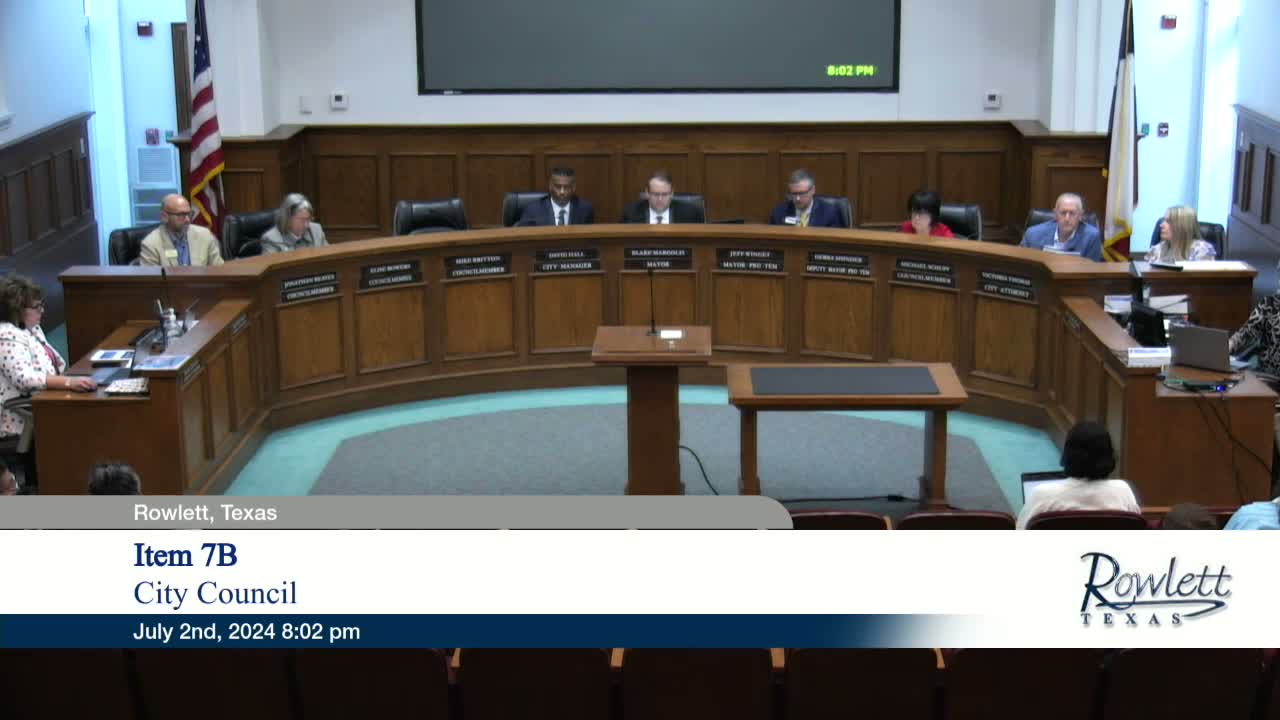
Rowlett council unanimously backs resolution urging reduced DART sales-tax allocation
Summary
The Rowlett City Council voted unanimously July 2 to support a symbolic resolution asking Dallas Area Rapid Transit to reduce the sales-tax allocation the agency receives from member cities, citing concerns about transparency, ridership accounting and the local return on investment.
The Rowlett City Council on July 2 voted unanimously to adopt a resolution supporting a reduction in the city’s allocation of sales and use tax revenues to the Dallas Area Rapid Transit (DART) authority.
Mayor Blake Margolis opened the discussion by framing the measure as a push for better accountability rather than a call to leave DART, saying the council’s action is intended to “incentivize an efficient operation that will benefit the riders, member cities, and DART.”
Why the council acted: The presentation and public comment cited several concerns. The council heard that Rowlett taxpayers have contributed roughly $138 million to DART since joining in 1983 and currently send about $10 million a year via the 1¢ member-city sales tax. The presenter said DART’s reported ridership remains about 30% below pre-pandemic levels while sales-tax revenues have risen, and raised questions about how DART counts trips (multiple segments counted as separate trips) and about gate malfunctions and delayed DART police response at the Downtown Rowlett Station.
Council members pressed for clarity on what the resolution would accomplish. Deputy Mayor Pro Tem Schinder described the resolution as a “symbolic” first step toward a larger, multistep effort and said it does not unilaterally change Rowlett’s membership or tax allocation; Councilmember Shoop and others said they supported the action as a way to request better transparency and encourage DART to produce clearer measures of value returned to member cities.
A spokesperson for Rowlett cited examples from DART’s FY2024 budget and local police data during the presentation, and council members noted DART returned $200 million to member cities in 2022 as evidence the authority has excess reserves. Councilmember Reeves and others questioned how returned funds had been allocated locally; the city confirmed the returned funds were distributed to other projects.
The council’s motion, made by Deputy Mayor Pro Tem Schinder and seconded by Councilmember Reeves, passed unanimously. The resolution requests a framework and negotiations with DART on a reduced allocation (presenters discussed a hypothetical reduction from 1¢ to 0.75¢). City staff said the action is primarily symbolic and part of a regional effort among member cities.
What happens next: Council members said this vote is intended to start a process with other member cities and with DART; the measure itself does not immediately change Rowlett’s tax rate or DART membership. The council did not specify the next procedural steps beyond continued engagement with member cities and follow-up work.
Quotes from the meeting: "This proposed resolution is not about dropping membership to DART," the presenter said, adding the goal was to address what he described as a "flawed business model." Deputy Mayor Pro Tem Schinder said the item is a symbolic first step toward broader negotiations.
The council closed discussion and approved the resolution unanimously.