Get Full Government Meeting Transcripts, Videos, & Alerts Forever!
Get email alerts on the Hillside Property topic
No spam. Unsubscribe anytime.
Elmbrook board hears strong public push to demolish Hillside and keep the land
Summary
At a November listening session, Elmbrook School District staff presented repair and enrollment data for vacant Hillside Elementary and outlined three options: keep, demolish and retain, or sell. Dozens of residents urged demolition and retention, asked for clearer cost bids and city coordination on zoning.
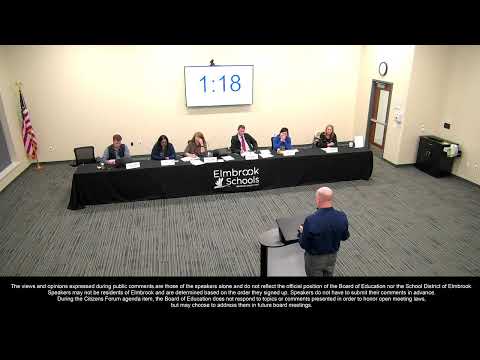
Elmbrook School Board President Scott Wheeler opened a November public listening session on options for the vacant Hillside Elementary property and turned the floor to Chris Thompson, the district’s chief strategy officer, for background and analysis.
Thompson told the audience the district’s master facility planning work considered three options: keep the building as‑is (with ongoing maintenance), demolish and retain the 9‑acre property, or sell the site subject to city permitting. He said the district currently spends about $34,000 a year to maintain Hillside and cited an architect’s assessment that the building is “end of life,” estimating roughly $1,800,000 in repairs over the next eight years to keep it viable. Thompson also noted the site’s roughly 9 acres is smaller than the 12‑acre guideline often used for new elementary schools and that district enrollment projections show no near‑term need to reopen the site as an elementary school.
Why it matters: the decision would trade upfront costs and neighborhood impacts against long‑term asset value and flexibility. The district’s 10‑year capital improvement plan, Thompson said, has funded about $60 million of work in recent years and currently lists roughly $72 million in future projects, so any Hillside investment would compete with other priorities.
Residents packed the listening session and nearly all speakers urged demolition and retention of the land or conversion to low‑impact, community uses. David Mikulski said, “I think you should demolish the property but maintain it in the portfolio,” calling a roughly $1 million demolition cost marginal compared with the district’s capital plan. Several speakers asked for competitive, itemized bids for demolition or repairs rather than high‑level estimates; Matt Jolliffe pressed the district to obtain specific contractor estimates and said the difference between repair and demolition costs would affect net offer values.
Neighborhood concerns focused on traffic, parking and the risk that a sale could allow incompatible uses. Katie Prestigard said she polled 68 neighbors and that “71% of responses favored an option that resulted in a community use,” proposing options such as a community garden or nonprofit lease that could provide educational benefits. Multiple residents asked the board to pursue a lease or partnership with the city so the district could retain ownership while enabling public park use.
City zoning and process: Mike Halquist, the alderman who addressed the meeting, explained the property’s conditional zoning lapses on a change of use and that, absent a rezoning, a new owner would have R3 (single‑family) build rights. “It reverts to R3 zoning, which is single family residential,” he said, and added that any rezoning would require a neighborhood information meeting and a public hearing — giving residents further opportunities to weigh in on specific proposals.
Board process and next steps: President Wheeler reiterated that placing a “for sale” sign was intended to test market interest and gather information; he said state law has changed since earlier practice (he referenced the Act 10 era), allowing the board to conduct negotiations in closed session while requiring any final sale vote to occur in public. No sale or formal action was taken at the listening session.
What residents asked for: multiple speakers requested (1) clearer, competitive cost estimates for demolition versus repair; (2) another public session or notice when specific offers are considered; (3) consideration of deed restrictions (some limited to preventing a competing school); and (4) stronger coordination with city officials about zoning, parking and park‑use options. Several residents urged the board to treat retained land as a district asset and to prioritize green‑space outcomes that minimize traffic and preserve neighborhood character.
The meeting ended after a final resident comment and a motion to adjourn. The board has not announced a timetable for next steps; any sale would require a public vote and, if a prospective buyer seeks a zoning change, additional city hearings and neighborhood meetings.