Get Full Government Meeting Transcripts, Videos, & Alerts Forever!
Get email alerts on the Education Monitoring topic
No spam. Unsubscribe anytime.
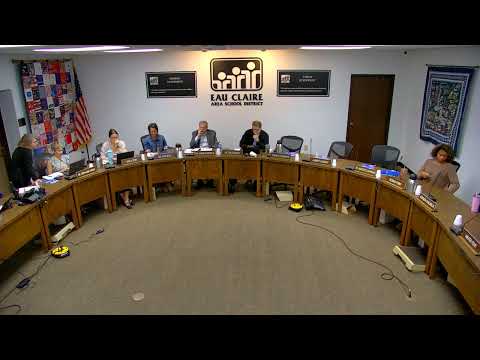
Eau Claire Area School Board approves R4 monitoring report amid concerns over student climate survey declines
Summary
The Eau Claire Area School Board approved its R4 monitoring report (Citizens of a Diverse Community) on Oct. 21, 2024, after a lengthy presentation and debate over student climate survey declines, measurement gaps and proposed tiered supports; the motion passed with one recorded no vote.
The Eau Claire Area School Board voted Oct. 21 to approve its Result Policy R4 monitoring report, after a presentation from Executive Director Van Vliet and principals about new supports and continuing data limitations.
Executive Director Van Vliet told the board the district has expanded student climate survey coverage and added prior-year indicators to the monitoring report, but cautioned that "student survey should not be the only measure that we are using" to assess R4. She said district leaders are building additional indicators, including a pre-K–12 learner profile tied to the district's portrait of a graduate, but that fuller outcome measures will not be in place until a future year.
The presentation described proactive and reactive strategies the district is rolling out to address student climate issues. At the school level, principals and leaders described implementation of a supportive learning environment framework and Positive Behavioral Interventions and Supports (PBIS) to create consistent adult practices. Michelle Wyberg, a building leader, said the changes produced concrete improvements this year: "This is by far and away the best start that we have had this year," and credited clearer expectations and consistent follow-up for fewer major referrals.
At Memorial High School, Dave Oldenburg described tier 2 and 3 systems such as dedicated ELT time for academic and SEL support, a check-in/check-out program for identified students and classroom conduct (SOAR) reporting that provides families with regular feedback. Oldenburg said those interventions and partner services help students access mental-health supports without immediately involving external agencies.
Several student representatives urged more attention to social media and phone use. Representative Ford said social media "has been a big issue" in student conflicts and suggested the district include instruction and conversation about healthy use and boundaries.
Board discussion centered on two points: the sharp declines shown in some climate indicators and the limits of current measures. Some board members urged more disaggregated, district-specific benchmarks and warned that several indicators have fallen substantially since 2021. Van Vliet noted limits in available student outcome metrics and said some survey data are anonymous and cannot be disaggregated by demographic fields.
After discussion, the board approved the motion to accept R4 as presented. The clerk recorded the roll call: Commissioner Nordine — Yes; Commissioner Azure — No; Commissioner Beaker — Yes; Commissioner Clements — Yes; Commissioner Farrar — Yes. The motion passed and the board chair noted the approval was not unanimous.
The board also approved routine consent items earlier in the meeting, including the superintendent's consent agenda (human resources report, gifts totaling $65,241.27 for Sept. 2024, payment of bills of $17,398,099.41 and net payroll of $6,358,106.11) and the board's consent agenda minutes from Oct. 7, 2024.
Next steps noted at the meeting: continue work to develop additional indicators (including the learner profile), maintain PBIS and tiered supports across buildings, and explore ways to collect or surface disaggregated data that can be trusted for monitoring. Director Van Vliet asked board members to complete the regular board self-evaluation in BoardDocs before adjournment.