Get Full Government Meeting Transcripts, Videos, & Alerts Forever!
Get email alerts on the Water Infrastructure topic
No spam. Unsubscribe anytime.
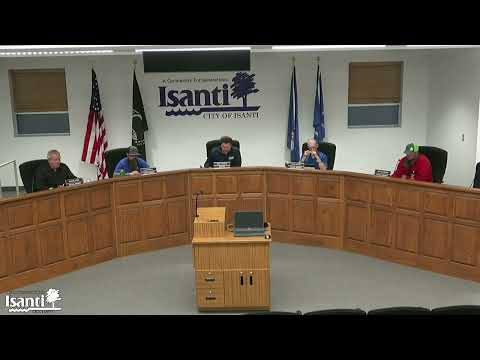
Isanti approves design work for Well No. 4 after debate over conservation and capacity
Summary
City council approved engineering services to advance design and permitting for a new Well No. 4 to boost firm capacity amid local growth; councilmembers debated whether further conservation measures targeted at high‑use accounts should precede the multi‑million dollar project.
The Isanti City Council voted 5‑0 to approve engineering services and move forward with design and permitting for a proposed Well No. 4 to increase the city's firm water capacity.
City engineering staff outlined three options discussed in prior meetings: rehabilitate an existing smaller well, drill a new well adjacent to an existing well (with recommended minimum spacing), or place a new well at a preferred city‑owned parcel on East Jewel Boulevard (referred to as location 4G). Staff said location 4G—on a city parcel north of the UPS site—would allow a utility easement without requiring acquisition of new land.
Council discussion focused on timing, costs and conservation. One councilmember urged the city to pursue additional conservation measures, including mandatory rain sensors or incentives for Wi‑Fi‑based irrigation controls for high‑use residential accounts, rather than immediately committing to a $2–3 million well project. Staff reported targeted outreach to large water users is already underway: letters were sent to residential accounts that exceeded 50,000 gallons in any month during the prior 18 months and staff are following up by phone; outreach to businesses and multi‑family properties has received positive feedback.
Staff presented preliminary cost guidance: the meeting packet noted a budget assumption around $2.25 million, with an estimate range of $1.5–$3 million and a current expectation near $2.4 million pending bids. Design services were proposed on an hourly ‘‘not‑to‑exceed’’ basis; staff observed that the not‑to‑exceed cap is a budget control and actual fees may be lower if the project proceeds smoothly.
Councilmembers also cited recent growth—including several apartment projects already in the pipeline—and city usage increases since 2019 of roughly 35 percent as reasons to proceed. After discussion, Councilman Lundin moved to approve the engineering services authorization and Councilman Merrill seconded; the motion carried 5‑0.
Next steps: staff will proceed with design, permitting and a bid process; the city indicated the implementation timeline could extend to 2026 for full system commissioning and that continued conservation outreach will remain part of the effort.