Get Full Government Meeting Transcripts, Videos, & Alerts Forever!
Get email alerts on the County Budget 2025 topic
No spam. Unsubscribe anytime.
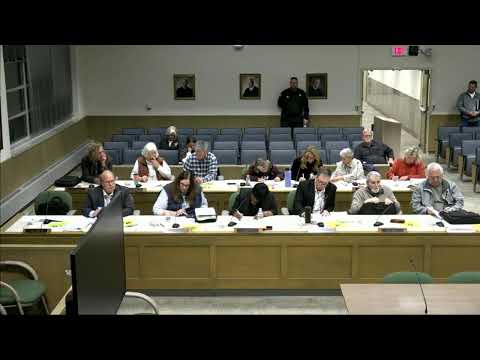
Rock County board adopts 2025 budget after votes on $1.9 million transfer, staffing changes and AV project
Summary
The Rock County Board of Supervisors approved the 2025 county budget following votes to transfer $1.9 million in excess interest to the debt service fund, several staffing reclassifications and a courtroom audiovisual capital project. The final budget passed on a 28–0 roll call.
Rock County’s Board of Supervisors adopted the county’s 2025 budget after a series of amendments and votes that included moving $1.9 million in unanticipated interest income into the debt service fund and several staffing and capital adjustments.
The board voted 28–0 (one absent) to approve the final recommended 2025 budget. Earlier in the meeting supervisors approved a resolution to transfer $1,900,000 in excess interest into the debt service fund to offset expenditures and help hold the tax levy steady; that resolution passed on a roll call of 23–5, with one member absent.
Why it mattered: supporters said the unplanned interest income made it possible to provide modest tax relief and avoid raising the levy this year, while opponents said using one-time funds creates a shortfall that will complicate the 2026 budget. “Every time we use one-time funds for these tax cuts, it creates a bigger hole that we have to fill next year,” said Supervisor Gorman, who voted against the transfer. “That is why I plan to vote no.”
Staff and several supervisors described the mechanics and trade-offs. A county staff member identified as Josh explained that applying the $1.9 million to lower the levy would yield roughly a 0.1% decrease in the levy this year but would require about $7.65 million in one-time sources in 2026 to maintain that position. “That’s the spirit of the question,” Josh said, calling it a policy choice for the board.
Key amendments that passed before final adoption included: restoring an administrative professional 1 position while deleting a vacant conservation specialist position; adding $50,000 to expand the Real Time Operations Center (RTOC) infrastructure for license-plate readers and closed-circuit cameras (funded from various Sheriff and property-sale sources); reclassifying a veterans benefit specialist to an assistant county veterans service officer (+$6,749 funded from veterans relief funds); increasing a part-time environmental health position from 0.5 to 0.7 FTE (+$16,947, offset by fee and grant adjustments); and several Department of Public Works reclassifications and wage adjustments funded from transportation aids.
The board also moved a courtroom audiovisual capital project into the 2024 budget after supervisors said AV failures in multiple courtrooms required prompt attention; that amendment passed on a 27–1 roll call.
What happened with wages and cost-of-living discussions: a separate, heavily debated proposal to increase the debt service levy by 1% to raise the budgeted COLA for county employees (framed as moving the COLA from 3% to 3.75%) failed by roll call, 3–25 (one absent). Staff and counsel clarified that approving budget lines does not by itself implement a COLA; a separate resolution would be required to change wages.
What’s next: the budget takes effect according to county procedures and staff said additional implementation items (such as any wage resolutions or more detailed allocations) will be brought back for separate actions. The board recessed briefly to confirm levy limits after the final vote.
Board actions recorded in the meeting minutes included multiple voice votes and roll calls on the listed amendments; the full record contains motions, seconds and recorded tallies for each item.