Get Full Government Meeting Transcripts, Videos, & Alerts Forever!
Get email alerts on the Charter Quorum topic
No spam. Unsubscribe anytime.
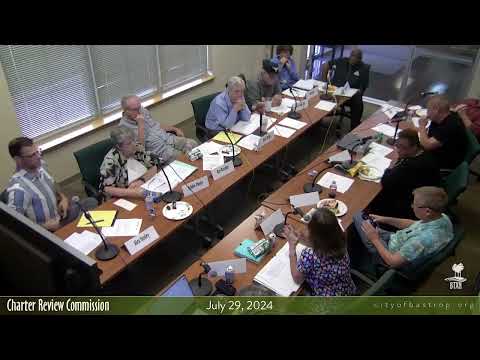
Bastrop commission adopts charter amendment to curb "walking quorums"; council-size proposal fails
Summary
The Bastrop Charter Review Commission approved an amendment creating two quorums—three for Open Meetings Act purposes and four required to conduct business—to curb informal "walking quorums." A separate proposal to add a council member failed for lack of the 10 votes needed to send a charter change to voters.
The Bastrop Charter Review Commission voted to amend the city charter to create separate quorum thresholds that supporters said will curb informal "walking quorums." The commission adopted an amendment to section 3.13 by a show-of-hands vote of 11–2.
The new language sets a quorum of three "for purposes of the Open Meetings Act"—intended to prevent a chain of private discussions among multiple council members from constituting a de facto public meeting—while retaining a heightened quorum of four members needed to adopt ordinances or resolutions. Alan, the city attorney, explained the legal intent: "The Open Meetings Act was adopted in the seventies...the magic number is the quorum," and he told the commission the charter may set its own quorum definitions and that bifurcating the threshold is legally permissible.
Discussion leading up to the vote contrasted two approaches. One proposal would have enlarged the council by one member (changing the body’s composition), which proponents argued could address quorum concerns as the city grows. That motion failed to reach the 10 votes required to refer a charter change to voters after an initial voice vote produced six 'ayes' and the chair announced the motion did not meet the required threshold.
Proponents of the adopted amendment framed it as a technical, voter-friendly fix. Supporters stressed the change would preserve a higher threshold for taking action while enabling the Open Meetings Act standard to apply at a lower number to discourage private coordination that circumvents public deliberation. Opponents warned the measure could limit informal deliberation among council members and risk overregulating routine discussions.
The commission’s action was procedural: the amendment will go to the next step required by the charter process to appear before voters for final approval if applicable. The meeting record shows the amendment passed 11–2; the larger council-size proposal did not reach the 10-vote threshold and therefore will not move forward from this commission.