
Bastrop planning commission workshop spotlights flooding, housing and trees in proposed B3 code changes
Get AI-powered insights, summaries, and transcripts
Subscribe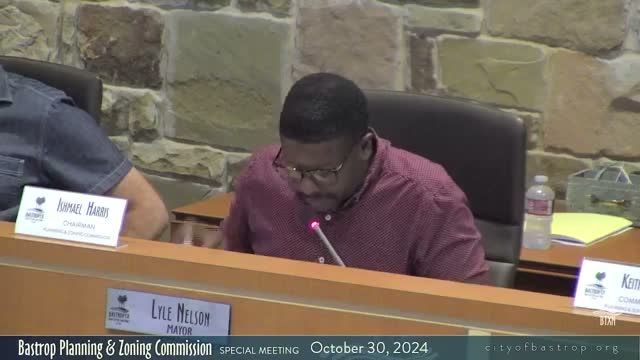
Summary
At an Oct. 30 workshop, Bastrop planning staff outlined proposed B3 zoning-code amendments that would loosen some parking limits, reduce impervious‑cover caps, tighten tree protections and limit accessory dwelling units (ADUs) unless infrastructure requirements are met; commissioners took no formal vote and will continue the review.
Bastrop — Planning staff and residents sparred on Oct. 30 over proposed amendments to the city’s B3 development code that aim to reduce flood risk, protect trees and steer how the city accommodates new housing.
At a workshop of the Bastrop Special Planning and Zoning Commission, staff framed the package as an effort to address flooding and water quality by tightening impervious‑cover limits, adding on‑site parking flexibility and strengthening tree protections while balancing housing needs. Sylvia (city planning staff) told the commission that the package grew from a year of outreach including past “code rodeos” and workshops, and emphasized that the items remain under discussion rather than final rules.
Why it matters: City staff said high levels of paved and impervious surfaces have increased runoff and flood risk and that the city faces significant drainage and street‑maintenance needs. Staff presented studies and cost estimates cited in the meeting — examples ranged from $20 million for drainage improvements in specific areas to larger, citywide figures presented earlier to council — and argued that reducing impervious cover across new development will limit future flooding and long‑term costs.
Key proposals and staff rationale
- Impervious‑cover caps: Staff proposed lowering residential impervious cover and reducing some commercial caps (staff cited a proposed commercial cap near 65% down from current figures discussed as 80% in some code tables) and returning residential caps toward 50% from a current practice staff described as effectively allowing up to about 60% in many new lots. Sylvia said research presented at the meeting links each 1‑percentage‑point rise in impervious cover to approximately a 3.3% increase in annual flood incidence, and that reduced caps would slow that trend.
- Parking and street design: The staff presentation focused on code language that divides lots into first/second/third layers and on how the B3 technical manual currently treats garage facades and alley entrances. One staff option would allow property owners to place on‑site parking in the front (first) layer as a right in areas where front parking already predominates; other options included returning to prior requirements encouraging alley entrances or retaining the current rule and variance process. Staff framed the change as both a matter of resident choice and a way to avoid forcing existing residents through repeated administrative variance processes.
- Accessory dwelling units (ADUs): The draft tables discussed reducing the by‑right ADU allowance from two units per lot to one, but staff said that additional ADUs could be approved administratively if the property can meet infrastructure and impervious‑cover requirements. Commissioners pressed staff on whether administrative review would create delays; Sylvia said staff intends administrative screening rather than full planning‑commission hearings when the math for infrastructure compliance is met.
- Tree protections and plant list: Staff proposed lowering the protected‑tree threshold from 13 to 10 caliper inches (citing authority in Texas local government code), requiring recent certified arborist surveys, and adding mitigation and penalty language. Two mitigation options were presented: a stricter standard (replacement trees with a minimum 4‑inch caliper) or a moderate approach (equivalent aggregate caliper with minimum 3‑inch replacement plantings). Staff also proposed updates to the preferred plant list — adding pecan, hackberry and other species — and agreed to consult Master Gardeners, Master Naturalists and the Native Plant Society before finalizing the list.
Public reaction
More than two dozen residents addressed the commission. Several business owners and long‑time residents urged adjustments that preserve downtown character while allowing practical parking options. Others warned that reducing ADU allowances risks undermining incremental affordable housing options for teachers, first responders and service workers. For example, Laura Munoz, a broker and property manager, urged preserving two ADUs per lot to support affordable rentals for essential workers. Jody Smith, who said people tied to Bastrop “need a place to live,” recommended keeping the current ADU rules or replacing numeric limits with clearer infrastructure‑based criteria.
Conservation and native‑plant advocates supported stronger tree protections and a native‑first plant list. Mike Goble of the Bastrop County Audubon Society praised additions such as hackberry and native willows for supporting birds and pollinators.
Points of dispute and staff responses
Several residents said the meeting packet included inaccurate statements about the current code (for example, whether on‑site parking was prohibited in the first layer). Cecilia Serna told commissioners the packet misstated existing parking rules and urged delay for further citizen review. Staff responded at length, reading code text and diagrams to explain how the code defines layers, where the code is silent, and how an administrative variance pathway has been used for existing nonconforming conditions.
Financial and implementation considerations
Staff repeatedly tied many proposals to the city’s drainage funding gap and infrastructure capacity. At the workshop staff described multiple cost estimates and plans presented to council and to consultants in recent months — including neighborhood and corridor drainage projects and a draft drainage master plan — and said full mitigation will require a mix of developer credits, impact fees, grants and long‑term maintenance commitments. Separately, staff noted the impact‑fee committee will review a proposed wastewater impact‑fee increase (a staff estimate cited in the meeting was roughly a $3,000 increase per connection to help offset a larger wastewater‑treatment project), and staff floated a community enrichment or park development fee (a suggested figure of $250 per unit was shown as an example) to help parks and trails.
What the commission did
No ordinance was adopted and no formal votes were taken on the B3 amendments. Commissioners asked clarifying questions, discussed outreach options and asked staff to refine draft language and charts. The meeting ended with a routine motion to adjourn that was approved by voice vote.
Next steps
Staff said the proposals will be refined in response to public comment, that the parks board will vet tree‑ordinance language, and that the impact‑fee committee will examine fee proposals. Commissioners discussed additional outreach and a planned joint discussion with the city council on the comprehensive plan in November to align master plans and city goals.
Reporting note: Quotes and attributions are taken from the commission workshop transcript. Technical references and numerical estimates above reflect figures and examples presented by staff and residents during the Oct. 30 workshop; where multiple cost numbers were cited in discussion, the article reports the range or staff characterization rather than merging inconsistent estimates.