Get Full Government Meeting Transcripts, Videos, & Alerts Forever!
Get email alerts on the Sports Complex Feasibility topic
No spam. Unsubscribe anytime.
Bastrop council hears preliminary feasibility study for regional sports complex; asks for more financial and parking detail
Summary
Consultants from Hunden Partners presented a preliminary feasibility study for a proposed regional sports complex at the Bastrop Industrial Park. Council members pressed on parking, hotel inventory, ownership structure and financing; consultants will return with demand, financial and economic‑impact projections in the coming weeks.
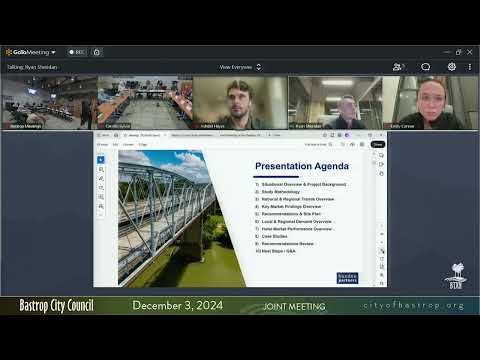
At a joint meeting that began at 5:00 p.m., the Bastrop City Council and the Bastrop Economic Development Corporation heard a preliminary feasibility presentation from consultants exploring a proposed regional sports complex at the Bastrop Industrial Park.
Ryan, a presenter with the Hunden team, told the council the study recommends a two‑phase approach: an initial outdoor complex of flexible turf fields that can be reconfigured for diamonds and later development of an indoor facility if market conditions warrant. "We have recommended a 2 phased approach for a project," Ryan said, describing phase 1 as eight full‑size multipurpose turf fields convertible into nine diamonds and phase 2 as a potential indoor complement.
A Hunden project executive, Mike, cautioned the council that Central Texas is already competitive and that an indoor facility could require a large upfront commitment. "You always have to be aware of what's going on from the fluidity of what's going on with your competitors," Mike said, and he cited indoor facilities that can exceed "60‑plus million dollar" capital costs as a reason to phase development.
Presenters summarized market research and interviews with tournament operators and regional clubs — including Bullpen Ventures, Perfect Game, USSSA and Lone Star Soccer Club — that indicated unmet demand for consolidated sites with 8–12 fields or multiple courts. Hunden also reviewed case studies from facilities in Florida, Iowa and Bryan, Texas, and noted the local hotel market has additional rooms under construction: two properties totaling roughly 225 keys, the team said.
Council members focused their questions on practical site issues, operating structure and financing. Multiple members expressed concern about parking capacity and distances between fields, restrooms and concessions on the conceptual site plan. Ryan said concessions and restrooms had been drawn between the upper quad fields and that detention‑pond relocation was discussed with Kimberly Horn, but acknowledged detailed master‑planning (including parking‑per‑surface metrics) will be part of the next phase.
Several council members and panelists said the city should avoid operating the facility directly. Cynthia (council) said municipal ownership “doesn't sit well with me,” arguing that private operators or a public‑private partnership (P3) are preferable to reduce operating risk; Hunden agreed that third‑party management is commonly used to optimize bookings and weekday programming.
A local hotelier, Sylvia, said Bastrop’s current hotel occupancy tax is 7% and argued an incremental venue/hotel tax could fund debt service without burdening residents. "Here in the city of Bastrop, ours is 7%," Sylvia said, adding that a modest increase would likely be borne by visitors rather than locals.
On funding, presenters outlined common tools used elsewhere — hotel‑tax increments, tax increment financing (TIF/TIRZ) and Chapter 380 incentives in the Texas Local Government Code — and warned that many youth‑sports complexes operate with public sector support for debt service or operations even when they generate incremental tourism revenue.
Hunden committed to send the full slide deck and to deliver draft demand, financial and economic‑impact projections in the next 2–3 weeks for council review. The council did not take any action on the study at the meeting and instead asked the sports‑subcommittee to review details and return recommendations. The meeting adjourned after a motion to adjourn carried by unanimous consent.