Get Full Government Meeting Transcripts, Videos, & Alerts Forever!
Get email alerts on the Transportation topic
No spam. Unsubscribe anytime.
Bell County rejects interim all‑way stop at Chaparral and Featherline after public hearing
Summary
After a lengthy public hearing with residents and engineers presenting crash and traffic‑volume concerns, Bell County Commissioners Court voted against establishing an all‑way stop at Chaparral and Featherline (motion failed, recorded 1–4). City and county engineers said a formal warrant study and traffic counts are needed first.
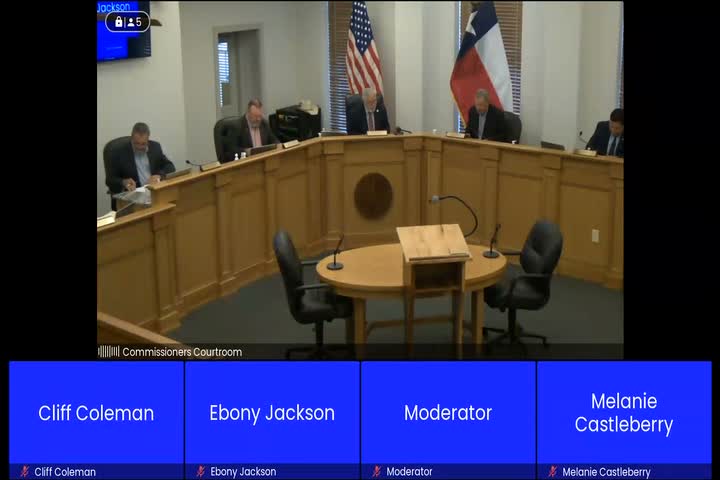
Bell County Commissioners Court heard more than an hour of public testimony and engineer briefings Aug. 12 about a proposed all‑way stop at the intersection of Chaparral and Featherline roads, a stretch adjacent to Chaparral High School and a newly opened middle school.
Residents and school representatives said the intersection becomes congested during peak school hours and described dangerous maneuvers when drivers try to enter or cross Chaparral. James Sills, who said he lives off Llewellyn Lane, told the court that peak‑hour traffic often forces drivers to detour and that motorists routinely rely on others to “let you take a left turn,” creating near‑misses. Student council president Alana Green, a Chaparral High School student, told commissioners that “an always stop sign would be a blessing” for families and student drivers.
County staff and engineers urged caution. The county engineer presented maps and the factors used under the Manual on Uniform Traffic Control Devices (MUTCD) and said the county had not conducted a full warrant study for the intersection. A staff slide noted eight reported crashes at the intersection in the past 12 months (reported source: 9‑1‑1 center) and highlighted pedestrian and vehicle volumes; a later public speaker said Featherline’s average daily traffic (ADT) had grown to over 11,000, a roughly 40% rise since 2020.
Andrew Zakers, identified as the City of Killeen city engineer, told the court the city is starting a consultant kickoff, plans to collect traffic counts after schools reconvene (in roughly two to three weeks) and expects to share a warrant study around October. County staff and several commissioners said that, because two nearby intersections sit about 1,200 feet apart, adding stop controls without modeling could cause traffic to “lock up” between signals or signs and create new hazards — for example increasing rear‑end collisions or blocking turning movements.
After extended discussion that referenced a county scope study estimate ($32,499) and possible temporary right‑turn lanes, the court took a voice vote on a motion to establish the all‑way stop. The motion did not pass; the clerk recorded the outcome as one in favor and four opposed. Commissioners who opposed moving forward without the warrant study said they were concerned that interim signs could make conditions worse and that engineers should evaluate the interaction of both nearby intersections first.
Next steps recorded on the record: the City of Killeen will complete traffic counts and a warrant assessment and share results with the county; Killeen police committed to providing traffic control for an initial week of the school term; county staff said they will continue evaluating temporary design options (including potential short‑term right‑turn lane work) and noted the court previously set aside $3,000,000 for Chaparral corridor improvements to be applied where feasible.
The public hearing and debate illustrated a split between immediate community pressure for action and engineers’ advice to gather on‑the‑ground data before installing multi‑way stop controls.