Get Full Government Meeting Transcripts, Videos, & Alerts Forever!
Get email alerts on the Subdivision Emilys Way topic
No spam. Unsubscribe anytime.
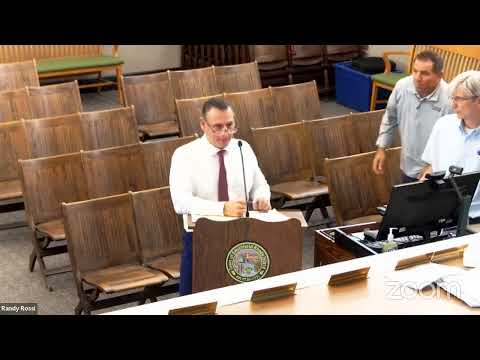
Board continues Emily's Way subdivision hearing after neighbors raise drainage, blasting and safety concerns
Summary
The Planning Board continued the public hearing on a proposed three‑lot subdivision on Old County Road after several abutters cited chronic flooding at a DOT culvert, steep grades (about 9.9%), ledge and blasting concerns; the applicant agreed to peer civil‑engineering review and to pursue DOT permission for culvert work.
The Smithfield Planning Board on Sept. 19, 2024, continued the public hearing on the Emily's Way three‑lot subdivision (260 Old County Road) after extended public comment from abutters who said the project could worsen longstanding drainage and safety problems on Old County Road.
Attorney Timothy Kane, representing KLRS Realty LLC (the applicant), said the three‑lot private subdivision seeks waivers from town standards — a reduced paved road width (20 ft vs. 30 ft) and a reduced platted right‑of‑way (30 ft vs. 50 ft) — and dimensional relief for Lot 1 (proposed 40,608 sq ft vs. the 65,000 sq ft minimum). Joe Casale, the project's engineer, told the board the applicant will seek DEM and DOT permits and that the design aims not to increase runoff. Casale also said the applicant plans to request DOT permission to replace the damaged culvert in‑kind (believed to be a 12‑inch RCP) and that the design will include measures (open channels, interception) to direct water to the wetland and culvert.
Residents, including Matthew Fague (247 Old County Road), Jane Testa (282 Old County Road) and Mary Campbell (270 Old County Road), testified at length about repeated basement flooding, the culvert's poor condition, the history of ice and accidents on the roadway, the area’s braided/overflowing streams, and concerns about blasting and ledge. Fague urged planting larger, more mature trees to provide an immediate visual buffer; neighbors also requested a pre‑blast survey and bonding if blasting is required.
Board members and staff asked that the applicant consent to an independent civil‑engineering peer review focused on grading and drainage. Casale and counsel agreed. The board catalogued contingencies to be verified during the peer review and permitting process: confirmation that runoff will not increase, DOT permission and bonding for any culvert work, a blasting survey and bond if blasting is needed, fire department acceptance of the road grade (plan shows approx. 9.8–9.9% grade), and a landscape plan specifying larger buffer trees. The board continued the hearing to allow the peer review and for the applicant to provide additional materials; the public hearing was left open and will resume at a later date.